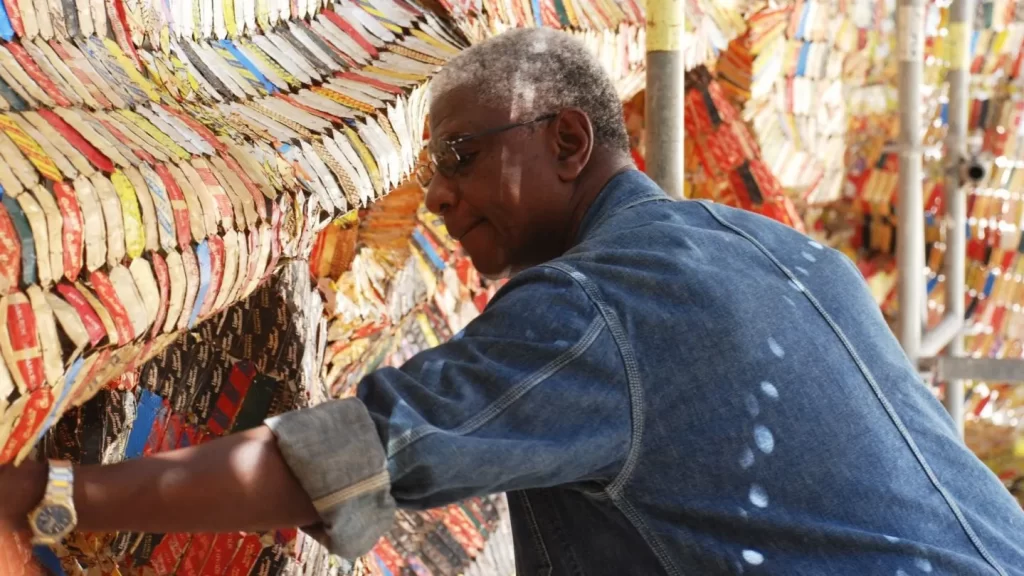
In the quiet of morning, light filters through the high windows of El Anatsui’s Nsukka studio. It is the same studio he has worked in for decades. There, discarded materials gather in restless, shimmering heaps. Among them are the thousands of liquor bottle caps that have become synonymous with his work, collected from local distilleries and sorted, flattened or twisted in preparation for transformation. Under the sunlight, their worn surfaces catch brief flashes of gold, bronze and copper, turning what was once industrial waste into a field of unexpected brightness.
Assistants move around the studio with practiced precision, repeating the familiar gestures that define Anatsui’s monumental installations: piercing metal, threading thin copper wire, linking fragments into fluid sheets that behave more like cloth than metal. It is a space defined by the kind of rhythms that allow scrap to evolve slowly into sculpture.
The environment reflects the essence of Anatsui’s practice: a process where the ordinary becomes luminous and discarded fragments gather into something vast and life. Here, the discarded is never truly lost, only waiting to be remade.
Roots, Formation and the Quiet Evolution of a Master
El Anatsui was born in 1944 in Anyako, Ghana, into a culture where everyday objects carried their own stories. This early sensibility defined the way he would later approach material and memory. He trained at the College of Art, Kwame Nkrumah University of Science and Technology, Kumasi, where he absorbed both formal technique and the philosophical grounding that encouraged his lifelong exploration of transformation.
In the early 1970s, he moved to Nigeria and began teaching at the University of Nigeria, Nsukka; a community whose intellectual energy and environmental spirit helped refine his artistic voice. His early practice focused on wood carving and ceramics. They served as mediums through which he explored language, identity and the histories embedded in African material culture.
By the late 1990s, a shift occurred as everyday metal became his canvas. Discarded bottle caps, aluminum fragments and the overlooked residues of consumption opened a new visual vocabulary for him. What began as an experiment grew into the monumental metal collection that would eventually redefine contemporary sculpture on a global scale.
Material: From Scrap to Meaning
El Anatsui’s materials began their lives far from the walls of museums. Most are discarded liquor bottles gathered from local distilleries across Nsukka; fragments of everyday consumption that would otherwise disappear into waste sites. In his studio, they arrive in sacks: crumpled, faded and carrying the quiet history of countless hands.
What happens next is a choreography of transformation. The caps are flattened, pierced, twisted, rolled or cut into shimmering fragments. Studio assistants, who are an essential part of Anatsui’s collaborative process, work these pieces by hand, creating thousands of small units. Each fragment becomes a module and each module a potential tile in a vast metallic language.
Copper wires link these elements together, forming large, pliable sheets that ripple like cloth. The surfaces gleam and undulate, evoking the texture of kente, the density of chainmail or the shifting luminosity of water seen at dusk. In their assembled form, these works refuse fixed definitions as they can be folded, stretched or re-hung into new configurations, making mutability and integral part of the art.
Read the full article here: PRAZZLE