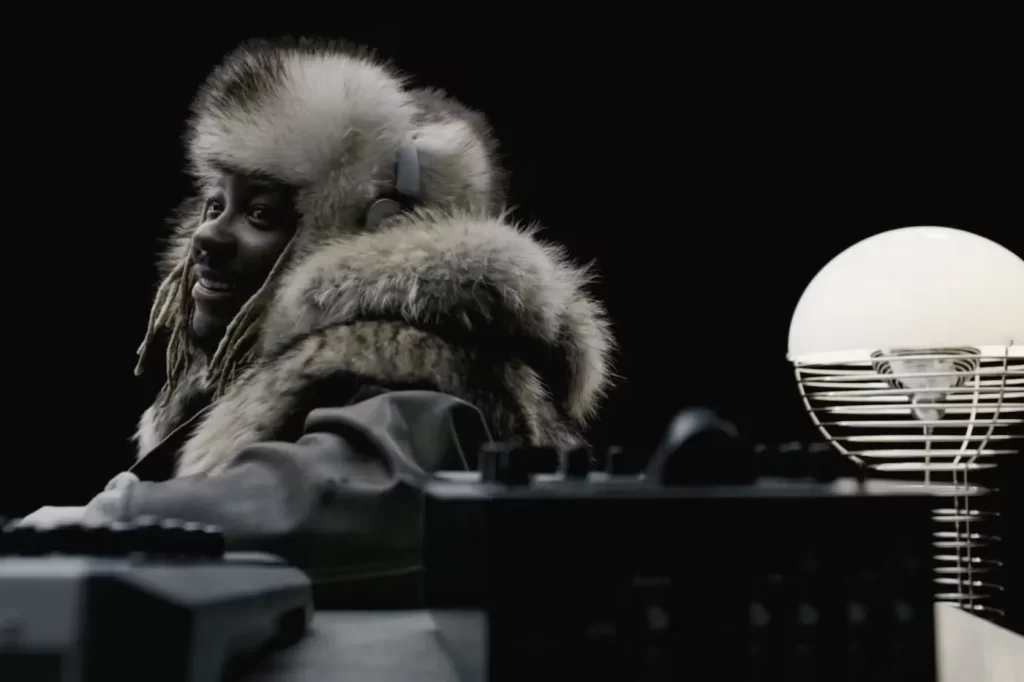
If there’s any remaining doubt about technology’s value in art, let 28-year-old creator Osean be the one to dispel it. The Atlanta-based multihyphenate is a 3D artist, musician and visual collaborator who’s worked with the likes of Playboi Carti, Doechii, and Offset. While his work is inspired by traditional anime, his saturated animations, best seen through his immersive Oseanworld series, embody a style and a virtual universe, completely of his own making. More recently, the creative has added Lenovo and Intel to his long list of collaborators, partnering with the brand on its Make Space platform.
Make Space is an initiative bridging the creative gap. Designed as a space for young people to explore emerging technologies, the programme provides mentorship opportunities, online resources, and interactive experiences aimed at encouraging experimentation. One of those experiences included the platform’s launch event last February, where Osean led a workshop on building digital worlds.
For its latest installment, Lenovo and Intel have launched the Make Space Network, an AI-assisted tool that helps creatives find collaborators. Participants answer a few quick questions and receive matches they can follow up with via email.
To mark the platform’s newest evolution, we spoke with Osean about his artistic journey, his relationship to AI, and how collaboration shapes his work.
How did your interest in the digital realm originate, and how has it evolved over the years?
OSEAN: I used to be an artist, a traditional painter. I always had an inkling of wanting to expand, so I went into concept art, and that kind of got me into 3D. I feel like it just kind of snowballed. I liked making videos, and then videos required me to learn 3D. Then, I started hanging out with people who were into VR, and they’d be like, “Hey, you want to make some worlds and stuff?” That helped me learn how to make video games. So, yeah, it was literally just a snowball effect of just making weird stuff.
Where did the names Osean and Oseanworld originate?
OSEAN: When I was in middle school, this guy and I used to draw comic books all the time in these composition notebooks. We had hundreds of them, and teachers would always take them. We were just having fun doing our thing. I also used to do this thing when we took family trips on cruises when I was a kid; I remember there was this one time I was out on the ocean, drawing in one of these sketchbooks, and I was just thinking, “I feel like the ocean is kind of like another world.” I was thinking too much about it – like, there are all these things you don’t know about it; you can get even deeper, and what’s on the surface is really cool.
That’s kind of how my brain works in a weird way. So, I just switched the ‘C’ with the ‘S’. In a definitional term for myself, that ocean (with a ‘C’) is literally a body of water, with multiple things in it, that encompasses its own world. And Osean (with an ‘S’) is just like my mind, essentially, and has the same thing where it’s just got all these things, worlds, and stuff wrapped inside my brain.
How would you describe your artistic style?
OSEAN: Manic expression, I guess. It’s usually just whatever I’m thinking of, or whatever plugs my brain for the day, and then I try to make it as fast as I possibly can. Other times, I try to use [my style] to help people with their artistic visions, which is also completely random. I didn’t even really think I had a style until I kind of realised that style is pretty arbitrary.
What do you think has influenced your style?
OSEAN: I like a lot of nature, spiritual stuff, and then [also] cartoons – like anime is really big. I also studied art history in college, and that was a big part of it, just knowing about older artists and basically being like, “How would I translate my work in the same way?”
I’ve noticed avatars are a major element of your work. What about creating and inhabiting those digital characters interests you?
OSEAN: It’s this thing I think about a lot – I feel like a lot of humans don’t portray themselves the way they want to. One, we have physical limitations on what we can do. And two, it’s also not acceptable to do a lot of the random stuff that we want to do. Blue skin, for example, is not a thing because we can’t make it – it would probably be really hard and dangerous. But in a video game, it’s a colour swatch, and people don’t even think about it. I like the idea of inspiring people to just kind of be who they want to be. If using these kinds of avatars is the easiest way to express yourself, then yeah, just use them to do what you want.
Read the full article here: DAZED