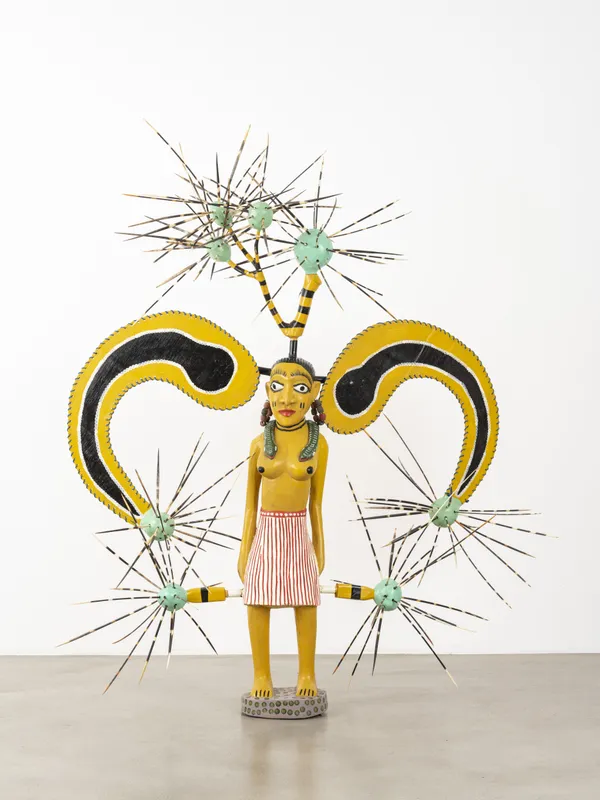
In 1989, the exhibition Magiciens de la Terre brought together one hundred artists from five continents. It was the first truly global exhibition.
It sparked intense debate at the time and has since become legendary. It revealed to Western audiences that contemporary art existed beyond their own cultural sphere. Thus, the painted house of South African Ndebele artist Esther Mahlangu was displayed alongside the monumental wall painting of the English artist Richard Long. The voodoo paintings and sculptures of the Beninese artist Cyprien Tokoudagba, as well as the aloalo sculptures of the Malagasy artist Efiaimbelo, were shown next to works by Claes Oldenburg, Christian Boltanski, and Mario Merz. By presenting Western and non-Western artists on equal footing, the exhibition offered a vision of remarkably diverse artistic practices. It heralded a new history of art.
In its new exhibition, the MAGNIN-A gallery brings together works whose diversity, specificity, and singularity lend themselves—through their content, meaning, and knowledge—to the idea of mapping an imaginary landscape defined by three spaces: Territory, Border, and World, understood as intensities rather than categories.
This imaginary map was created by André Magnin and Jacques Soulillou for their book Contemporary Art of Africa, published in 1996 by Harry N. Abrams and Thames & Hudson.
Territory encompasses works connected to earthly forces rooted in a specific culture. These forces may be religious, ritual, or social. Artists working within a tradition belong to Territory. The aloalo of Efiaimbelo, the paintings of Esther Mahlangu from KwaNdebele in South Africa, and those of Cyprien Tokoudagba are powerful examples.
World is aligned with the realm of signs—what circulates and is shared. Artists such as the Congolese Bodys Isek Kingelez and Chéri Samba, the Ivorian Frédéric Bruly Bouabré, and the Malian Amadou Sanogo belong to this space. They work with transcultural concepts, using objects or iconograms drawn from multiple cultural sources.
Border includes artists such as the Sierra Leonean John Goba, the Tanzanian George Lilanga, the Congolese Moke, and the Beninese Calixte Dakpogan. Their works engage both with the forces of Territory and those of signs. One is therefore never permanently situated within Territory, Border, or World, but is constantly traversed by shifting intensities that shape thought and creative expression.
The Museum of Modern Art in New York has recently devoted solo exhibitions to Frédéric Bruly Bouabré and Bodys Isek Kingelez. The latter, along with the Senegalese artist Seyni Awa Camara, will be featured this year in the international exhibition of the Venice Biennale, where non-Western countries are also opening new pavilions—further evidence of a changing artistic landscape and the emergence of a new global history of art.
Source: MAGNIN-A