Southern Guild makes its debut at Art Basel Miami Beach with a presentation of sculpture, assemblage, photography and paintings, marking a defining moment in the gallery’s expanding international programme.
Founded nearly two decades ago on the principles of collaboration and cultural preservation, the gallery has become a vanguard for progressive contemporary voices from Africa and its diaspora. With a foothold on two continents – in South Africa and the United States – Southern Guild continues to advocate for authentic cross-continental discourse. The fair follows a year of significant expansion in the gallery’s fair programme, including lauded first-time presentations at Frieze Los Angeles, Frieze New York and Frieze London.
Exhibiting painting, sculpture, assemblage and photography, Southern Guild’s booth foregrounds unconventional approaches to materiality with several artists having pioneered distinct technical processes. Together, these practices articulate a language of form, material intelligence, and conceptual depth, interrogating frameworks of race, gender, economic disparity and spiritual belief at the heart of decolonial imagination. The presentation includes works by: Zanele Muholi, Roméo Mivekannin, Kamyar Bineshtarigh, Zizipho Poswa, Chloe Chiasson, Ambrose Rhapsody Murray, Dominique Zinkpè, Ayotunde Ojo, Marcus Leslie Singleton, Manyaku Mashilo, Usha Seejarim, Nandipha Mntambo, Bonolo Kavula and Amine El Gotaibi.
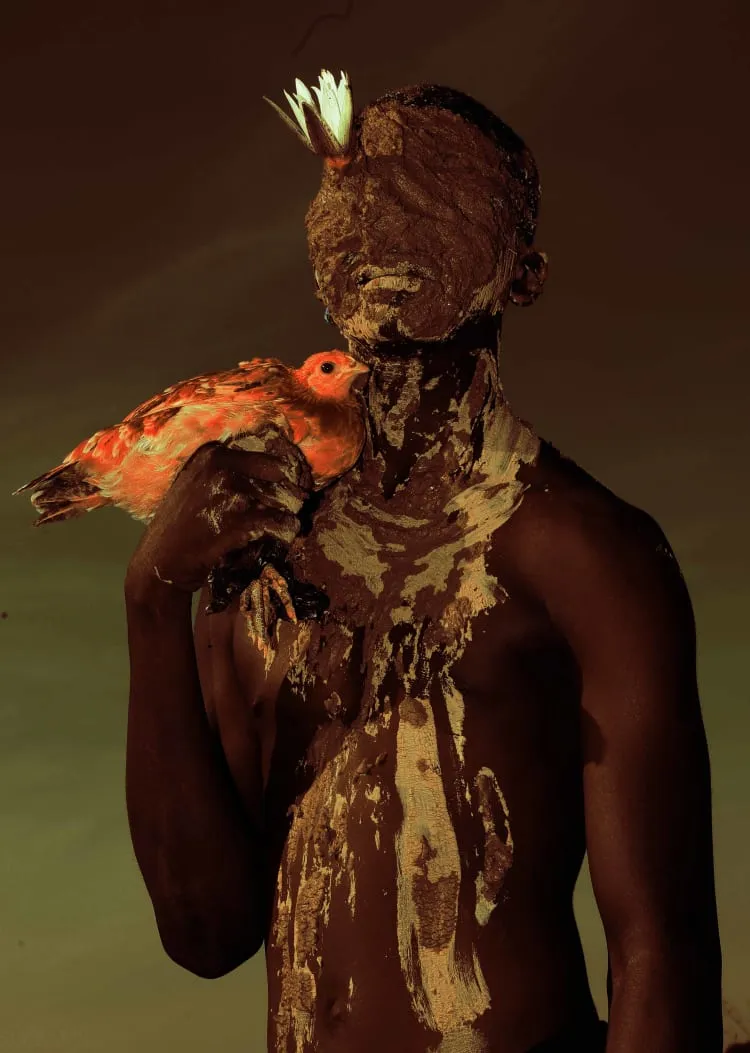
Following Zanele Muholi’s debut of new material explorations at Frieze London, the South African visual activist’s oeuvre continues to redefine the language of contemporary portraiture. Muholi presents new photographic works from their seminal Somnyama Ngonyama (Hail the Dark Lioness) series – one rendered as a photographic lightbox, the other as a large-scale print on aluminium. Through these material translations, Muholi expands their sustained meditation on race, gender, and the politics of visibility, building a vital transnational archive of self-hood and Queer being.
In a cultural moment of increasing precarity for Queer freedoms, Chloe Chiasson and Ambrose Rhapsody Murray deploy their practices as vehicles for self-determination. Chiasson’s dimensional reliefs merge painting, collage and assemblage. Her layered tableaux offer counternarratives to the heteronormative mythologies of the American South, rendering Queer desire and identity as both stage and sanctuary. Like Chiasson, Murray disrupts the image of another icon of American machismo, utilising the car as an ephemeral symbol for memory, familial myth and aspirational commodity. Through a process of material experimentation, fragmentation and reconstruction, Murray imbues her works with a visceral sense of longing and reinvention.
Roméo Mivekannin and Ayotunde Ojo’s specially commissioned paintings confront the enduring legacies of fetishism and the ethnographic gaze through divergent strategies of figuration. Based between France and Benin, Mivekannin merges portraiture with historical revisionism, inserting his own likeness into canonical Western paintings. His forthcoming solo exhibition will open at Kunsthalle Giessen in Germany this November. Where Mivekannin performs an overt act of revision, Nigerian artist Ojo manifests a quieter refusal in his oil, acrylic and charcoal paintings. Depicted within everyday domestic settings his subjects turn inward to reclaim their psychological and spiritual autonomy.
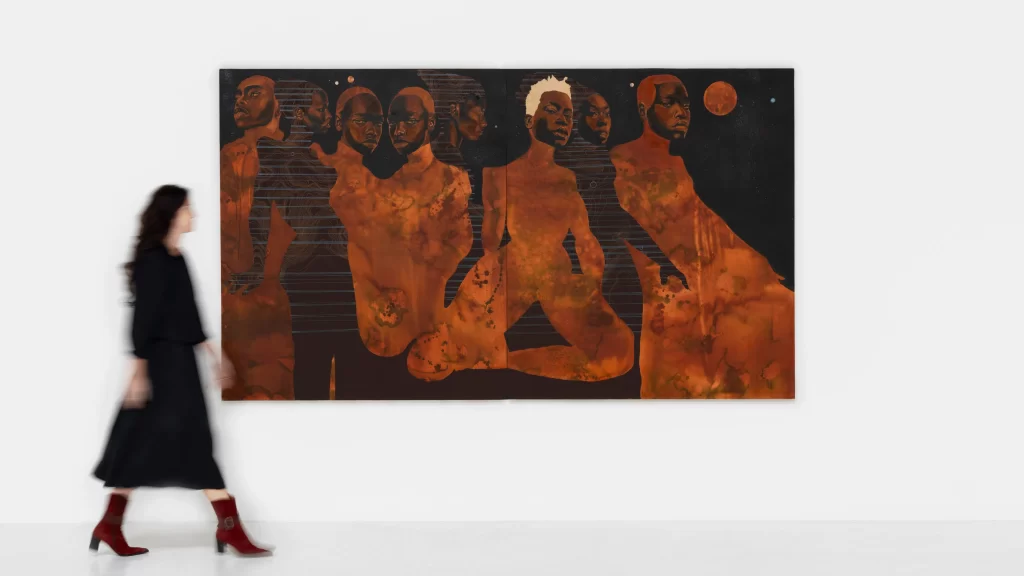
South African artist Manyaku Mashilo’s large-scale Afrofuturist diptych envisions speculative futures grounded in community and transcendence. Mashilo traces the matrilineal transfer of knowledge, invoking the objects, teachings and rituals passed down as guiding forces in her family and Sepedi culture. Cloaked in red ochre, her figures, at once celestial and earth-bound, inhabit realms that collapse distinctions between past, present and future. Akin to Mashilo’s conceptual perspective, Marcus Leslie Singleton explores the intersections of Queer identity, spirituality, and contemporary social realities. Showing with the gallery for the first time, the
Seattle-born artist presents narrative scenes that embody the dissonant multiplicity of Black being, the ecstasy and hardship, the tenderness and complexity of private and public life.
Kamyar Bineshtarigh’s Brett’s Studio Wall, offers a broad meditation on authorship and markmaking. Extracted from over twenty feet of interior wall space in a fellow artist’s studio, the expansive work formed part of Bineshtarigh’s 2025 solo exhibition at Southern Guild Cape Town,
titled Group Show. The Iranian-South African artist’s material interventions – involving layered cold glue, wall paint, ghosted script and incidental studio detritus – function as both linguistic and historical excavations, reimagining surfaces as archives of presence, absence and generative creative labour.
Johannesburg-based artist Usha Seejarim contributes a new assemblage composed of wooden clothes pegs, transforming the weighted language of domesticity into poetic structure. Seejarim’s sculptural reliefs speak to everyday ritual, gesturing towards invisible economies of care, the complexities of motherhood and women’s work. The fair follows Seejarim’s participation in Le Sel Noir – Perspectives on Black Contemporary Art at Städtische Galerie, Bremen and precedes Seejarim’s solo with Southern Guild in the US in 2026.
A new sculptural wall hanging by Amine El Gotaibi combines steel and wool with a visceral physicality that has come to define the Moroccan artist’s practice. El Gotaibi’s work explores dichotomies between nature and society, with a particular focus on his native North Africa and the broader continent. His work investigates both external and internal perspectives on African identity, consistently pushing boundaries in scale and ambition.
Zizipho Poswa’s ceramic and bronze sculpture dismantles hierarchies between the domestic and the monumental. Isacholo, standing nearly ten feet tall, upscales a traditional Xhosa bracelet believed to hold healing properties. The sculpture, first shown as part of the South African artist’s
solo exhibition Indyebo yakwaNtu (Black Bounty) at Southern Guild Los Angeles in 2024, was most recently included in Between Distance and Desire: African Diasporic Perspectives at the Soloviev Foundation in New York.
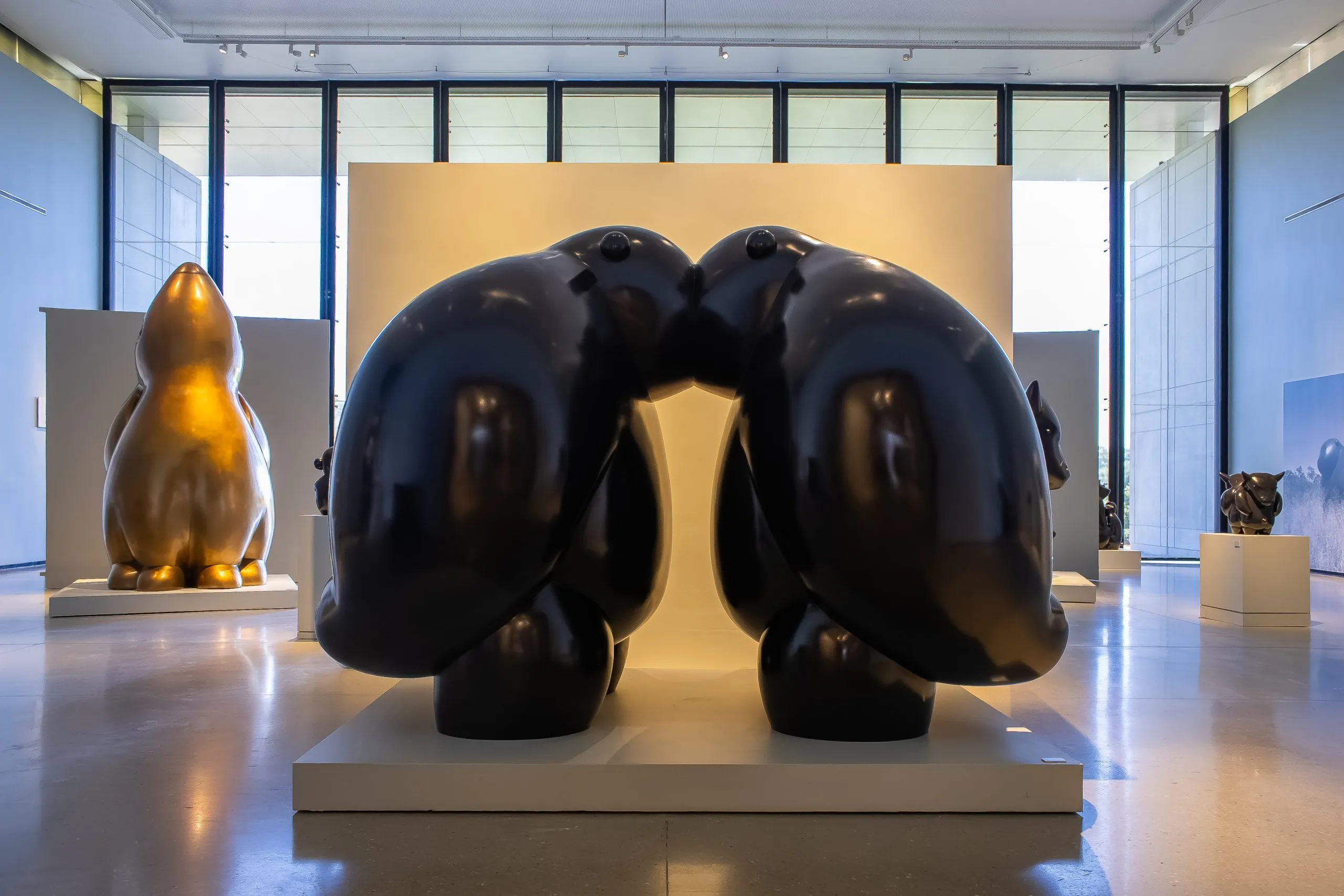
In dialogue with Poswa’s formal vernacular, Dominique Zinkpè’s bronze totems seeks to preserve and animate the Vodun spiritual beliefs of traditional Yoruba culture. Cast from one of the artist’s hand-carved timber sculptures, the work channels ancestral energies into contemporary form. A seminal figure on the continent, Zinkpe’s work can be found in the Zinsou Foundation (Benin), Blachère Foundation (France), Zeitz MOCAA (South Africa) and Sindika Dokolo Collection (Angola).
Southern Guild’s presentation affirms the gallery’s sustained commitment to amplifying the visibility and critical discourse of resonant African voices. The fair marks a moment of curatorial and creative fruition, a culmination of years dedicated to asserting a singular and compelling vision within the global contemporary field.
Source: Southern Guild