Author: Leila Chik
Between market recalibration and regional realignment, 1-54 Marrakech 2026 unfolded as a moment of consolidation rather than spectacle. Positioned alongside the launch of Art Basel Qatar and bought by a maturing collector base, the Moroccan edition of the fair confirmed its strategic role within the global art ecosystem. Beyond the corridors of La Mamounia, an expanded OFF programme and a growing South-South circulation signalled a structural shift: no longer a platform of visibility alone, 1-54 is becoming a site where contemporary African art negotiates its integration, its canon, and its future.
At La Mamounia, the choreography begins long before the doors officially open. Chauffeurs idle outside as collectors adjust sunglasses against the winter sun. Advisors exchange brief nods in the marble lobby. Inside, the atmosphere is measured rather than electric. The corridors at 1-54 Marrakech resist spectacle. They invite conversation, reflection, and negotiation. Here, the art fair functions less as a stage for competitive visibility than as a laboratory of positioning.
The global art market in 2026 continues its recalibration. Post-pandemic exuberance has given way to strategic selectivity. Auction houses report stabilization rather than acceleration. Collectors acquire fewer works, but with sharper criteria and longer-term thinking. In this climate of precision over volume, 1-54 Marrakech positions itself not as a rival in an overcrowded calendar but as an instrument of focused exchange.
Held from 5 to 8 February 2026, the seventh edition gathered twenty-two galleries and nearly seventy artists. Its boutique format reflects an ideological choice: intimacy over expansion, depth over breadth. Yet this year’s alignment with the launch of Art Basel Qatar introduced geopolitical resonance. Rather than eclipsing Marrakech, the overlap revealed a regional rebalancing. The Middle East and North Africa are no longer peripheral, they are structural nodes within global art circuits. If Doha represents capital consolidation and institutional ambition, Marrakech signals relational density and continental dialogue. The distinction is strategic rather than competitive.


Market Figures and measured optimism
Beyond atmosphere and positioning, the numbers at 1-54 Marrakech 2026 offer a revealing snapshot of market maturity. While the fair maintains a compact format with twenty-two galleries, the price spectrum reflects increasing stratification. Emerging artists such as Adjei Tawiah and Méné were presented in the €6,000 to €18,000 range, depending on scale and medium. Works on paper and smaller canvases tended to move quickly during the preview, particularly among younger Moroccan and West African collectors building first serious acquisitions. Mid-career painters like Chigozie Obi saw works priced between €25,000 and €45,000, with larger compositions approaching €60,000. According to a Moroccan gallerist participating in the fair, “Collectors are no longer afraid of the €40,000 mark if the narrative and institutional trajectory are clear. Five years ago, that psychological threshold was much lower.” Textile-based practices occupied a slightly higher conceptual bracket. Joana Choumali’s embroidered photographic works were positioned between €35,000 and €75,000, reflecting her international visibility and museum presence. “Those works don’t sit long,” the same gallerist noted. “They’re seen as historically grounded and internationally validated.” In the upper segment, modern and historically anchored works commanded six-figure expectations. Pieces by figures such as Karim Bennani or carefully sourced works by Roland Dorcély entered the €80,000 to €150,000 bracket, depending on provenance and rarity. This inclusion of modern masters alongside contemporary names signals a notable shift: collectors are constructing narratives across generations rather than isolating contemporary production. According to the gallerist, the fair’s “real strength sits between €20,000 and €70,000, that’s where serious consolidation happens.” She added, “We had fewer impulse buyers this year, but stronger commitments. Clients returned twice, sometimes three times. That tells you something about confidence.” Overall, while 1-54 Marrakech does not compete with blue-chip mega-fairs in raw volume, it demonstrates a healthier depth across segments, from emerging to modern. More importantly, intra-continental acquisition is rising. “The most interesting change,” the gallerist concluded, “is seeing African collectors buying African artists here, not waiting for London or Paris to validate them first.”
The Market Lens: From What to Collect to What to Sustain
The 2025 “What to Collect” focus published by Diptyk already suggested a market in transition. Rather than privileging singular blue-chip names, the editorial selection highlighted a plurality of trajectories: emerging figuration, materially driven abstraction, sculptural experimentation, and the reactivation of modernist legacies.
This shift was visible again in 2026. Nigerian painter Chigozie Obi, whose series Shades of Black celebrates Black corporeality through chromatic intensity, exemplifies the renewed appetite for figurative painting that refuses caricature. The works do not rely on exotic appeal, they articulate self-defined representation. That confidence translates into collector trust.
Similarly, Moroccan artist Bouchra El Menjra’s bas-reliefs — constructed from reclaimed materials and extending dialogues initiated by the Casablanca School — demonstrate how abstraction rooted in local history can resonate internationally. Her practice exemplifies a broader tendency: collectors are increasingly attentive to works that anchor contemporary experimentation within genealogies rather than trends.
Ivorian artist Méné’s quasi-mystical compositions, oscillating between organic abstraction and cosmological suggestion, reflect another market evolution. Rather than chasing stylistic uniformity, buyers now seek conceptual depth. Ghanaian artist Adjei Tawiah’s use of nylon sponge (referencing cleansing, domestic labor and resilience) similarly merges material metaphor with social commentary.
The Diptyk selection also foregrounded historical modern figures such as Roland Dorcély, signaling a crucial market expansion: the reintegration of modern African art into contemporary collecting circuits. That dialogue between modern and contemporary continued in 2026. The presence of works by figures such as Karim Bennani reinforces this continuum. Collectors are no longer dividing their attention strictly between emerging contemporary names and Western modernism; they are constructing narratives that situate African modernism as intrinsic rather than peripheral.
This maturation of collecting culture suggests something essential: Marrakech is no longer merely a discovery fair. It is becoming a site of canon negotiation.


The Social Choreography of the Fair
What distinguishes 1-54 Marrakech from its counterparts is not only what hangs on the walls but what circulates between them. The fair unfolds through a subtle social choreography. Advisors move discreetly between suites. Young Moroccan artists linger at thresholds, absorbing signals about pricing, presentation, and positioning. Conversations oscillate between English, French and Arabic, reflecting the city’s layered linguistic identity.
In the early hours of the preview, transactions are swift but discreet. By mid-afternoon, the pace slows. Collectors return for second viewings. Negotiations unfold quietly in adjacent rooms. Unlike larger fairs where momentum is relentless, Marrakech allows hesitation. Hesitation here becomes productive. It allows consideration.
A notable shift lies in the profile of buyers. Beyond established European collectors, there is visible participation from North and West African patrons whose acquisitions signal intra-continental circulation. This South-South exchange remains under-reported in global market analyses, yet it may represent one of the most significant long-term developments. African collectors purchasing African artists on African soil reframes the geography of validation.

A Structured Ecosystem
Over the past decade, Marrakech has transitioned from episodic meeting point to coordinated cultural circuit. During a studio visit in Tahanaout, artist Mourabiti reflected on this evolution: “Before, it was only Al-MAQAM*, and it was part of the cultural circuit. Now they organise studio visits with Mou, Fatiha, me and artists in residency. It’s a way to open space for everyone, beyond VIP, beyond galleries. It shows foreigners that Morocco isn’t only folklore.”
His observation highlights a shift not only in scale but in structural ambition. The fair no longer exists solely as marketplace; it operates as hinge between production, circulation, and discourse. Collectors now plan their February itineraries around 1-54. European, American, Gulf and West African patrons converge. Advisors accompany clients. Moroccan students and emerging artists circulate with professional intent rather than simple curiosity.
Sales during the VIP preview reflected diversified appetite. Painting remains strong, yet textile-based practices, ceramic works and sculptural installations demonstrated steady movement. Photography retained conceptual gravitas. Buyers appear increasingly attuned to narrative depth rather than surface appeal.
Memory, Material and the Politics of Craft
Material tendencies at the fair reflect broader theoretical preoccupations with memory and embodied knowledge. Textile practices do not merely reference craft traditions; they interrogate them. Embroidery becomes archive. Woven fibres suggest continuity across generations disrupted by colonial histories and urban migration.
The prominence of such practices in Marrakech is not accidental. Morocco’s artisanal heritage operates as implicit backdrop. Yet artists resist folkloric reduction. They re-code traditional techniques through contemporary frameworks. This dynamic resonates directly with Mourabiti’s insistence on moving beyond surface exoticism. The works do not perform tradition, they question its afterlives.
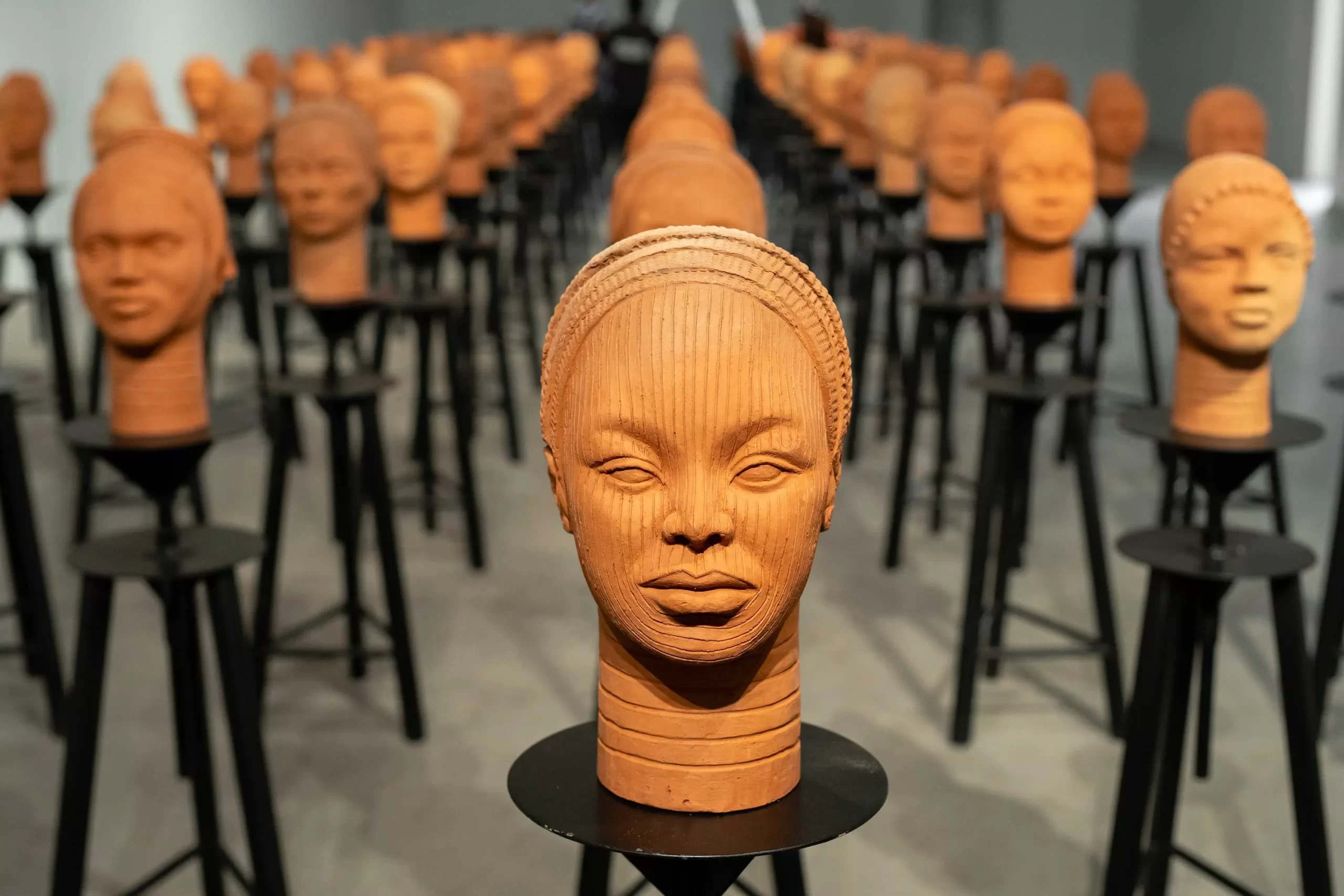
Sculptural works engage similar material politics. Clay vessels evoke ritual and domesticity, yet their placement within the fair context reframes them as contemporary propositions rather than ethnographic artifacts. The shift from anthropological gaze to conceptual engagement is subtle but decisive.


Booth Presence and Curatorial Strategies
Several booths crystallised the edition’s tonal direction. Loft Art Gallery presented Joana Choumali’s embroidered photographic works, whose layered threads function simultaneously as aesthetic gesture and mnemonic intervention. Galerie 38 showcased ceramics and sculptural forms that slowed circulation and required viewers to dwell. Smaller galleries opted for focused solo presentations privileging narrative cohesion over visual overload. Figurative painting maintained presence, yet its language has shifted toward introspection and psychological tension. Textile practices proliferated, with embroidery functioning as inscription rather than ornament.
Photography’s conceptual expansion was evident across multiple stands. Whether engaging staged identity or archival layering, works demonstrated that photography now occupies a theoretical space equal to other mediums within contemporary African practice.


Touria El Glaoui and Strategic Integration
Since its foundation in 2013, 1-54 has repositioned its mission. Founder Touria El Glaoui articulates this evolution: “Today, it is no longer just about visibility, but about a true integration of the African continent into the global discourse on contemporary art.”
Integration implies permanence, continuity, and reciprocity. El Glaoui also situates Marrakech as a distinct platform: “Marrakech has always occupied a distinct place. It is a meeting space on the continent where artists, gallerists, collectors, and institutions can exchange directly, free from constraints often associated with Western markets.”
Her emphasis shifts the narrative from exhibition to encounter. “Our objective is to create conditions for a durable presence and not simply momentary visibility.” Durability signals structural ambition rather than episodic spectacle.


The OFF: City as Counter-Structure
If La Mamounia concentrates attention, the OFF disperses it across the city. Thursday’s Gallery Night activated Guéliz. Storefront galleries hosted openings while rooftop terraces became stages for extended conversation. Street corners filled with informal dialogue. The city’s rhythm became integral to the fair’s tempo. Studio visits in Tahanaout provided an even deeper counterpoint. Gravel underfoot. Open doors. Works in progress leaning against walls. Collectors shed VIP badges and entered working environments.
Mourabiti elaborated: “We have artists who work in different ways, with their own research.”
The OFF did not function as decorative supplement but as parallel ecosystem. Pop-up exhibitions unfolded in riads. Hotel patios hosted installations. Foundations presented special projects. Late evenings blurred into informal salons where artists articulated structural concerns and curators debated acquisition ethics. The OFF produced density that the hotel suites alone could not sustain.


Infrastructure and Structural Fragility
Growth reveals gaps. Morocco has limited fine arts institutions, primarily in Casablanca and Tetouan. Independent criticism remains sparse. Educational infrastructure lags behind market momentum. Mourabiti addressed these tensions candidly: “We need figures who can invest intelligently, who can support artists. We need art critics, which we barely have. In the South, there’s nothing. Artists learn on their own. That is both beautiful and difficult.”
His remarks foreground the interplay between market maturation and intellectual scaffolding. Without criticism, pedagogy and institutional depth, integration risks remaining superficial.
The central tension of 1-54 Marrakech 2026 lies between continental specificity and global integration. El Glaoui’s formulation on moving from visibility to integration encapsulates this shift. African contemporary art is no longer framed as emerging novelty but as constitutive component of global discourse. Yet integration carries risk: dilution, assimilation, homogenization. Marrakech’s strength lies in preserving friction. Its scale, rootedness and layered urban fabric resist total assimilation. That friction sustains dialogue.

Presence as Policy
By the final afternoon, the corridors of La Mamounia grow quieter. Works have been marked with red dots. Conversations taper. Crates await repacking. Yet what lingers is not transactional residue but structural momentum. 1-54 Marrakech 2026 did not pursue spectacle. It pursued equilibrium. It balanced global ambition with local anchoring, market pragmatism with curatorial inquiry, exclusivity with permeability. In a volatile art world, equilibrium is not passivity. It is strategy.
The fair’s maturation mirrors that of the market it helped shape. From improvisational beginnings to structured integration, from episodic visibility to durable presence, the trajectory is clear. And as the city returns to its ordinary rhythm, one realizes that the true measure of 1-54 lies not only in what was sold but in what was sustained: conversations, networks, commitments, and the slow architecture of cultural integration.
*Al-Maqam is an artist residency created in 2004 by artist Mohamed Mourabiti, in Tahannaout, 30km from Marrakech.