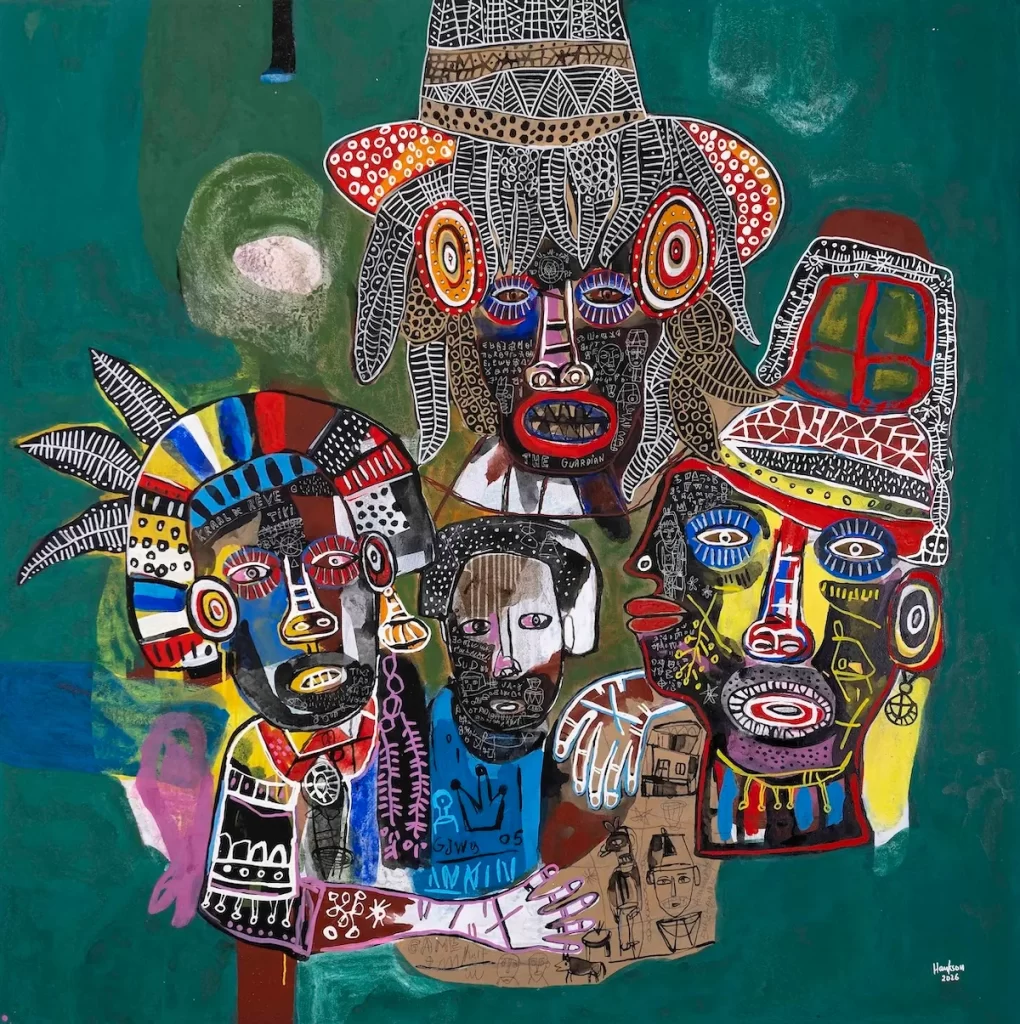
In one of the most recent canvases produced by Hako Hankson during his residency in Casablanca, a word charged with history surfaces almost unbidden: epic. Are we living through epic times, worthy of being told? Has History, with its procession of misfortunes, returned with force after seeming to recede? What does it mean to paint when one is far from one’s homeland—here, Cameroon, marked by political tensions—when concern for those back home resurfaces, when thoughts of one’s own never leave? While art sets itself apart from what the poet Mallarmé called “universal reportage”—that is, the relentless commentary on a world that is not quite right—it nonetheless remains permeated by the conflicts that run through us all. The painter’s most recent series is thus rooted in a strong cultural foundation, and while portraiture continues to dominate, the narrative—as well as epic and mythic—dimension of this work now emerges in its full universality.
For someone rooted in ancestral rites and divinatory ceremonies specific to the Bamiléké region where he was born, the world is governed by a constant dialogue between opposing yet complementary principles. On one side, totemic figures of patriarchal power stand as organizers of a social and political life governed by immutable laws; on the other, maternal figures embodying matriarchal strength shape an intimate and familial sphere defined by care and protection. This distribution of roles, which some might view as conservative, should instead be understood as a form of harmony that does not exclude forms of emancipation. Portraiture thus affirms, in an almost anthropological sense, the structuring of a world whose principles and forms of wisdom seem timeless.
Hako Hankson celebrates a world of heroes and heroines whose roles span centuries. Alongside tribal chiefs— intercessors between the world of the living and that of the ancestors, recognizable by their masks sometimes adorned with feathers—appear female figures, at times cradling a child, acting as intercessors between generations, identifiable by their rich adornments and finely detailed headdresses, crafted by the artist using Posca markers. These figures are inseparable from birds which, for the painter and the community to which he belongs, symbolize intermediaries between the world of the living and the beyond, much like ritual statuettes and masks. For this series, Hankson also draws on the iconography of masks from Papua New Guinea, which recall those of his native Cameroon, as rituals and symbols share deep anthropological constants. Are human beings not shaped by the same desires and imaginaries, despite their differences?
Yet it would be reductive to assign this work a purely ethnographic dimension. On the contrary, it is constantly nourished by a dialogue with an art history that is, by nature, universal, and with its Moroccan context of production, which one might describe as fraternal. A kinship of spirit connects these portraits to Picasso’s Cubist painting, itself informed by the fascinated discovery of what was once termed “primitivist” art. Totemic masks and sacred statuary here recover their full visual force. But it is above all with urban art—particularly graffiti, with its immediacy of execution—that Hankson’s work resonates. While the often monochrome backgrounds are carefully worked, drawing remains the catalysing force of the canvas. First sketched in broad strokes, with a controlled inclination toward caricature or satire, drawing forms the structural backbone of each portrait.
It also appears within the canvas through a series of small marker-drawn vignettes depicting scenes of everyday life. Musicians, gatherings of elders, passersby at leisure: a shared frontality shapes these images, often accompanied by phrases reminiscent of graffiti or by letterforms borrowing from hieroglyphs or calligraphy. A desire to narrate life in all its inexhaustible diversity becomes apparent. A discerning eye will notice here a motorcycle taxi—whose drivers are known as “bendskins” in Cameroon—elsewhere a cart that seems almost fused with the donkey pulling it, bearing the letters “MARR”, evoking the city of Marrakech. Finally, an intergenerational dialogue emerges with a recognized figure of contemporary art, whose name is inscribed across several canvases: Abdelkrim Ouazzani. Hankson discreetly echoes his hybrid, anthropomorphic creatures—his skeletal fish or wheel-birds—as a gesture of affinity toward an art that is spontaneous, free, and playful; much like Picasso, who said he spent a lifetime learning to draw like a child.
Source: L’Atelier21