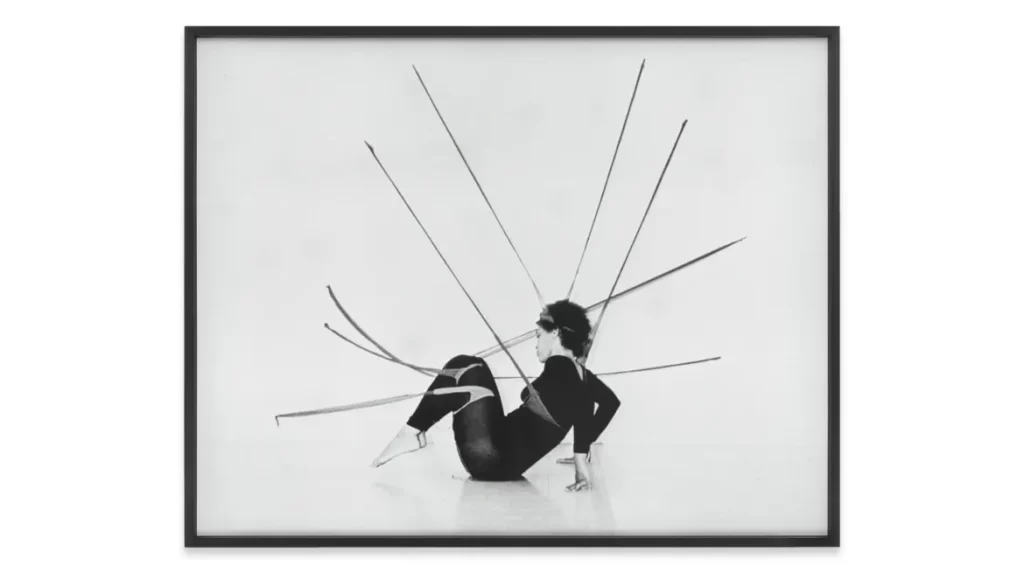
Whitechapel Gallery presents a rare archival exhibition of the work of pioneering artist and educator Senga Nengudi (b.1943, Chicago, USA). Featuring photographic works, archival materials and films of key performance pieces, the exhibition offers audiences unique insights into Nengudi’s work and practice.
Born in Chicago, and raised in Los Angeles, Nengudi was a key figure in the avant-garde Black art scenes both in Los Angeles and New York during the 1960s and 1970s that were characterised by their radical experimentation, collective practices and social commentary. Nengudi’s influential and groundbreaking works sit at the intersection of sculpture, choreography and performance and draw on a range of African, Asian and Native American art forms.
The presentation focuses on a selection of Nengudi’s most iconic works made between 1972 and 1982 – a pivotal moment in her artistic development. During this period, Nengudi refined both her approach and creative forms, building on a background in dance and art. She was also influenced by avant-garde collectives and practices including Fluxus, the Gutai group, Yoruba mythology, Japanese Noh theatre and jazz improvisation. Her distinctive and evocative sculptural forms were assembled from a variety of found objects and materials such as hosiery, sand, rocks, seed pods, masking tape and paper, and designed to be animated by spontaneous or choreographed interactions, creating powerful participatory works.
Works on display include original photographs of Nengudi’s seminal work, R.S.V.P. (1976), as well as a film of a later performance of the piece. R.S.V.P. comprises an evolving series of works combining sculptural forms with performance activations; it was her first that used nylon tights as the primary material. After the birth of her first child, Nengudi became intrigued by the changes in her own body and the societal impact on women’s body image following childbirth. Her use of hosiery is significant, referencing gender constructs, but also, through the elasticity and flexibility of the material, operating as a potent symbol of resilience and subversion. The tights were pulled, twisted, knotted and filled with sand, tethered to gallery walls or stretched across the space evoking cavernous womb-like structures or body parts such as breasts or bellies. R.S.V.P. provided an immersive and sensual arena for physical interaction and Nengudi invited frequent collaborator – dancer and choreographer Maren Hassinger – to activate the work through movement.
R.S.V.P. is shown alongside photographic documentation of other performance works including Performance Piece (1977) and Performance with Inside Outside (1978), to further illuminate the development of Nengudi’s engagement with flexibility and tension. The presentation also includes a triptych of photographs from Nengudi’s Spirit Flags series, an important body of work created in New York in the early 1970s, that paved the way for the later performance works. The flag-like forms, hung outdoors in alleyways and across fire escapes, were animated and set in motion by the wind, rain and other environmental factors, igniting the artist’s interest in how external forces affect the movement and form of objects.
Also on display is a film capturing the collaborative work Air Propo (1982), an improvised performance by Nengudi with dancer, vocalist and performer Cheryl Banks Smith and musician Lawrence D. “Butch” Morris. Alongside the performances of Banks Smith and Morris, Nengudi practices circular breathing techniques, transforming her own body into an instrument. The work was made for the pioneering gallery Just Above Midtown (JAM) in New York. A dedicated and significant space for African American artists and artists of colour to present their work, JAM demonstrated the ethos of improvisation and collaboration vital for performance-makers at this moment. Nengudi was also part of a close-knit community of Black artists in Los Angeles, including Maren Hassinger and David Hammons, collectively known as Studio Z. A key part of their work was to facilitate communal spaces for African American artists to experiment with forms and practices outside the mainstream art world.
This exhibition marks the first solo presentation of Senga Nengudi in a public gallery in London, following her 2018 survey exhibition at Henry Moore Institute, Leeds, and Fruitmarket, Edinburgh. It is shown alongside a major survey of Veronica Ryan at Whitechapel Gallery, putting the two artists in dialogue and highlighting Nengudi’s influence on Ryan’s work.
Source: Whitechapel Gallery