Buthelezi’s multidisciplinary practice is rooted in material exploration, cultural continuity, and spiritual enquiry, drawing on Indigenous knowledge systems as frameworks through which to consider contemporary existence. Working predominantly with traditional Zulu materials such as ‘icansi’ (hand-woven reed mats), ‘tankrali’ (Zulu seed beads) and glass beads, Buthelezi engages in the existential undertaking of ‘ukubuyela emasisweni’ or “returning to the source,” reimagining intergenerational materials as carriers of memory, knowledge, and spiritual inheritance.
In Kala, Buthelezi extends this enquiry into the realm of measurement, asking how we might take account of ourselves and the world at a cultural moment of uncertainty. The isiZulu imperative that is the title translates to “weigh it” or “measure it,” invoking both the logic of calculation and the limits of it. In a pervasive societal milieu where value is increasingly determined by metrics, productivity, and modes of extraction, Buthelezi attempts to measure what refuses calculation: hope, memory, collective dignity, spiritual inheritance, and the distance between who we are and who we might yet become. What forms of knowledge remain, she asks, when conventional systems of measurement no longer suffice?
Across the exhibition, spheres, topographies, concentric circles, and fragmented landscapes manifest as recurring forms. The works recall celestial maps, geological formations, and ancient tools of navigation, occupying a material and conceptual space between the terrestrial and the esoteric. These forms become tools with which Buthelezi attempts to locate the self within a world that feels increasingly unstable: to take measure of how far we have strayed, what has been lost, and what might still be recovered. Rather than describing the world, the works propose another way of reading it, one where intuition and calculation, matter and memory, the mundane and the metaphysical coexist.
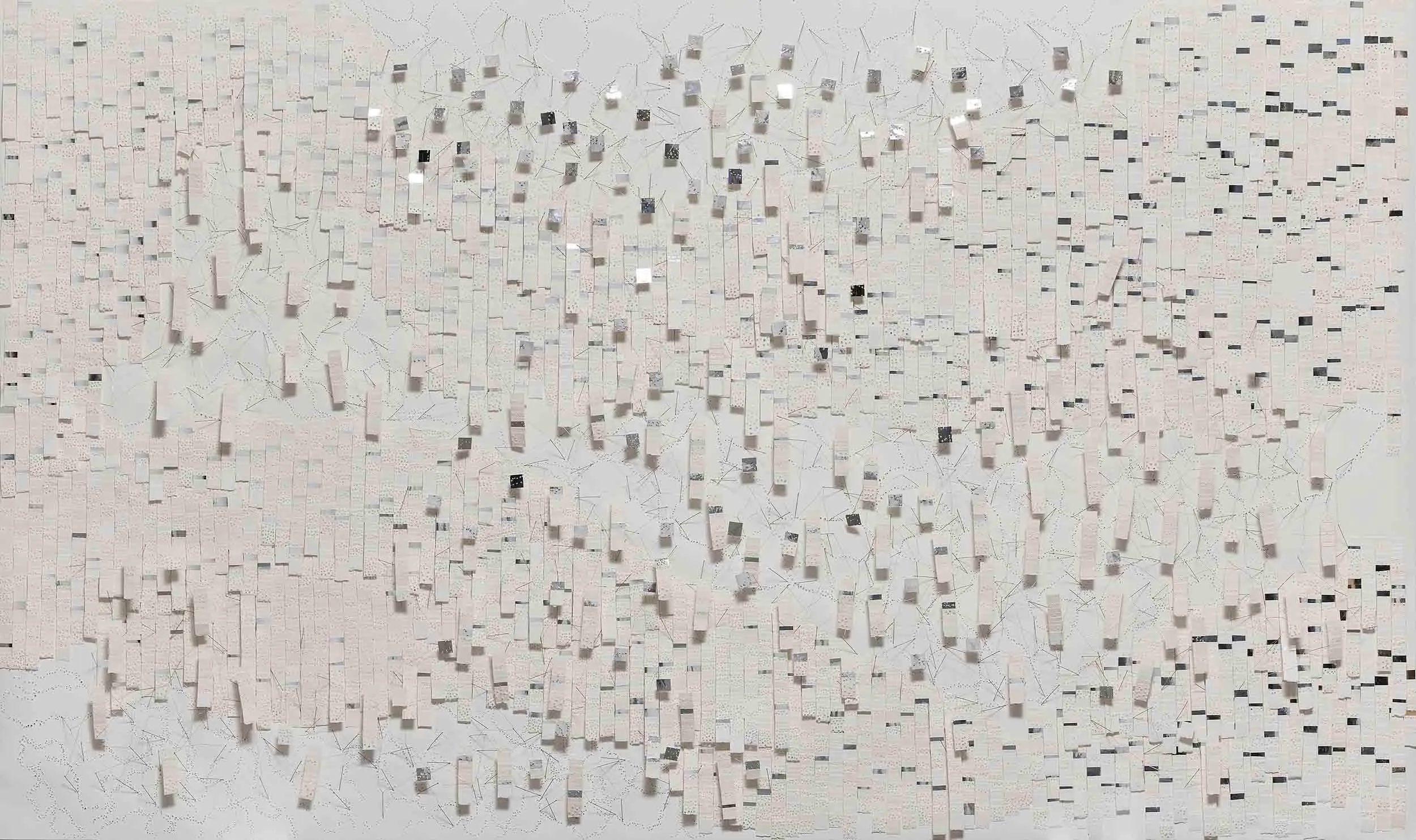
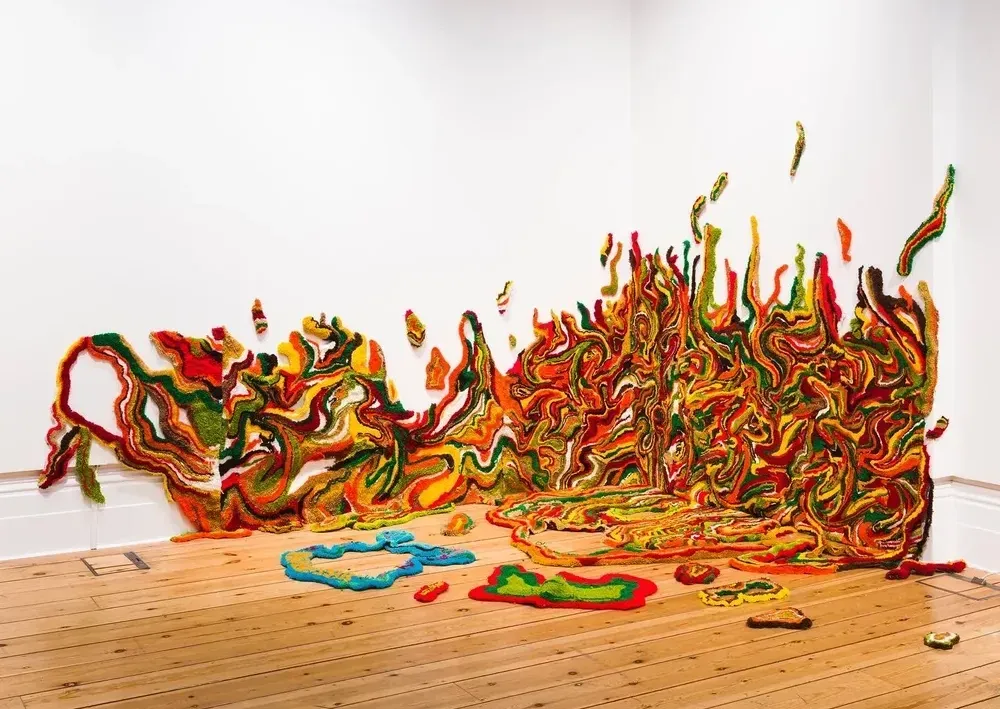
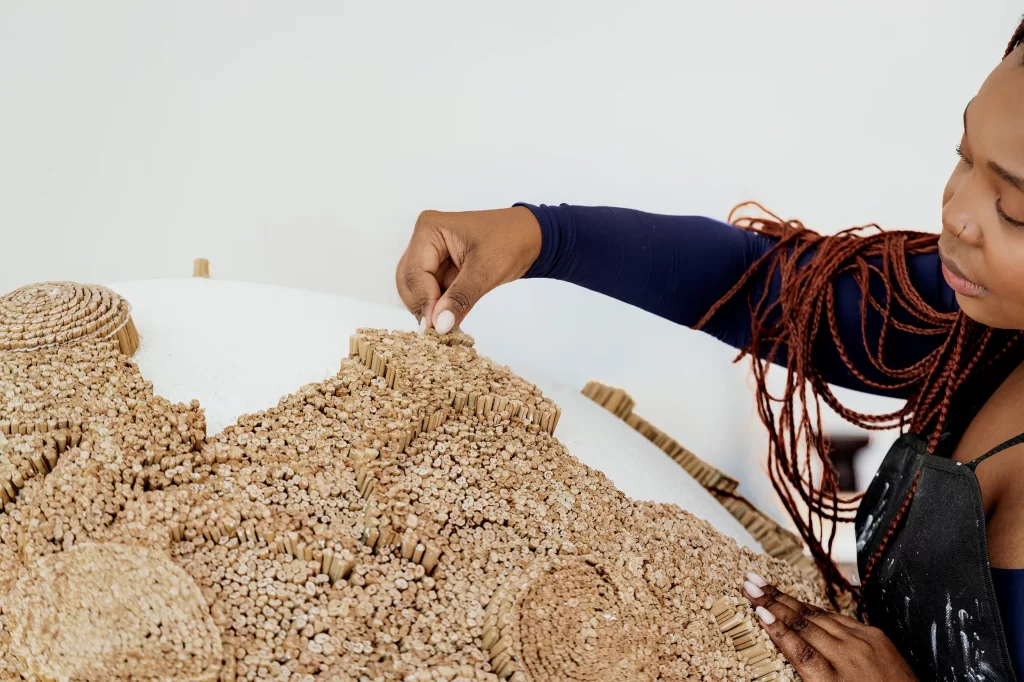
Through repetition and methodical labour, she treats materials as carriers of knowledge: repositories of information that can be accessed, exchanged, and transformed through making. Glass beads, natural fibres, clay, and found earth matter are layered into densely worked surfaces that record time as much as form. The work unfolds intuitively. Rather than imposing meaning onto the materials, Buthelezi allows it to emerge through sustained engagement with them.
This sustained engagement with material becomes a form of measurement in itself. Every reiterated gesture, woven strand, and positioned bead records duration, attention, and embodied labour, transmuting time itself into a visceral presence. In Kala, calculation becomes less about arriving at certainty than about cultivating a heightened awareness of the relationships that bind body to landscape, the individual to the collective, and the present to ancestral, multi-directional time. Making becomes a mode of enquiry through which systems of knowledge are not illustrated, but both preserved and produced.
A monumental sphere, titled Mhlaba, becomes a focal form for the exhibition’s central themes. Neither complete nor intact, the work appears suspended in state between formation and erosion. It evokes the Earth, but also a charged body; one marked by extraction, transformation, and latent potential. Its surface is layered with tactile constellations built from cut segments of ‘icansi’, traditional mats hand-woven from iNcema bulrushes. Used across South Africa in ceremonial, ritual and domestic contexts, these mats carry cultural and spiritual significance that extends beyond their everyday function.
The Abacus, an extensive wall-hung installation, transforms an ancient tool of calculation into a distorted meditation on what cannot be counted. Ebonised, handmade clay beads shift across a series of open contour lines. Released from the confines of the abacus’s conventional four-sided boundary, the instrument becomes mutable and porous, exposed to forces of motion, time, deduction and addition. Together, the exhibition’s recurring forms – orb, contour, grid, and horizon – function less as symbols than as devices of orientation. They suggest that the act of measuring is inseparable from the act of locating oneself: within history, within landscape, within inherited frameworks of knowledge and belief.
This search for orientation is also a return to the source. “I am aware that I am ancient”, Buthelezi has shared, gesturing toward the understanding that this knowing moves across generations through ritual, ancestral lineage, spiritual gifts, and the embodied act of art-making. Her materials become a didactic device, a kind of spiritual technology: holding information from the past, while generating new insights for those who come after. Here, making is simultaneously an inward journey and an outward act of transmission, locating the artist within a continuum that extends beyond the limits of an individual lifetime.
Kala proposes that before we can imagine a way forward, we must first take account of the conditions of the present, quantifying not only what has been lost through extraction and dehumanisation, but also what continues to endure through connection, ritual, and community. Ultimately, Kala asks not how we measure the world, but what we choose to measure. It invites an alternative currency of value; one rooted in attention, care, and the belief that making remains a vital way of processing the conditions of the present.
Source: Southern Guild Cape Town