Adam Pendleton
(b.1984, Richmond, Virginia, USA)
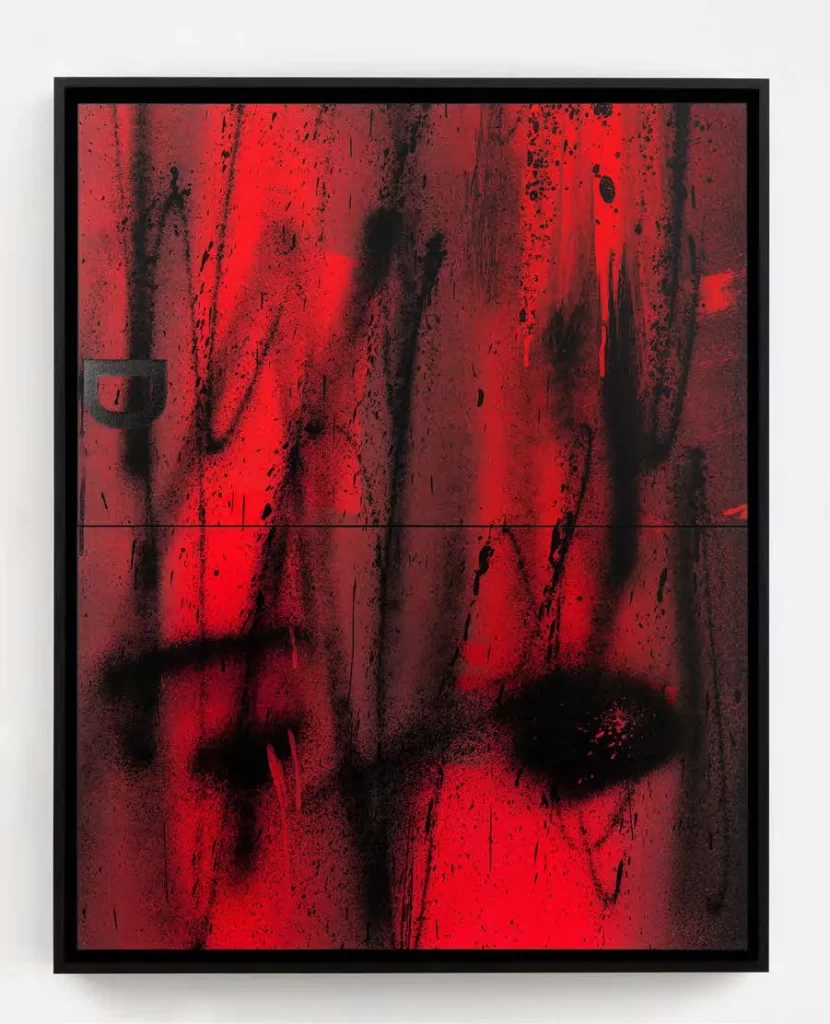
Since he began making art in the early 2000s, Adam Pendleton has developed an expansive approach that employs gesture, fragment, text, and image to re-contextualize histories of painting, Blackness, abstraction, and the historical avant-garde. Deploying collage as model and method, Pendleton places traditionally separate ideas and processes in close proximity, creating an uneasy, fluid state that opens up new spaces for thinking and seeing. Black Dada (D) (2025-26)affirms a continuity in the artist’s pictorial language, while introducing a new dimension through the use of vibrant color, a method that has become prominent in Pendleton’s recent paintings. Rendered in black and purple, the work marks a new significant path in his practice, which has previously been limited to black and white. As if adding a new chapter to his ongoing Black Dada manifesto, color now operates alongside recurring symbols of black letters, traces and splatters, creating a form of abstraction marked by a sensory dimension. Disrupting familiarity, the legibility of the work points to a textural field of difference, further deepened by the break between two canvases, each marked with an “A”, yet unified within the same frame. This structural duality acts as a filter through which the unfamiliar becomes recognizable, and the recognizable slips into the unfamiliar.
Antonio Ballester Moreno
(b.1977, Madrid)
The work of Antonio Ballester Moreno arises from a careful attention to the slow rhythms that shape both experience and existence. Attentive to the passage of time and natural cycles, his paintings often invite to abandon the fast-paced flow of modern life and instead embrace a way of moving through the world on a sensory level. Landscapes and celestial bodies become central motifs in his work, creating pictorial fields shaped by colors and forms that seek to intuitively evoke the perceptive and emotional aspects of empirical experience, unbound by linear temporalities or topological spatiality. An in-between field is then created, one in which night becomes day, celestial bodies become the sun, watery blue merges with the green landscape, and the sun sets and rises amidst the oranges of the sky, dictating both beginnings and endings. Inspired by childlike imagination and histories of pattern, Ballester Moreno’s compositions become richly elemental, conveying what is most essential through a visual language that is at once universally comprehensive and deeply subjective.
Berlinde De Bruyckere
(b.1964, Ghent, Belgium)
Inspired by art history, religious and mythological iconography, literature, poetry, and cinema, as well as by the visual registers of social and political contexts that resist indifference, Berlinde De Bruyckere’s practice consistently addresses the temporal and corporeal conditions of vulnerability and suffering inherent to the experience of finitude. Through a plastic language that seeks grace as much as the rawness of reality, her work mediates existential themes carried by an unsettling material and formal repertoire composed of salvaged elements.
Through this aspiration to nurture life even in its most fragile and withering condition, it is unsurprising that, when asked to choose which painting she would envision keeping in her private home, De Bruyckere selected Cristo Morto Sorretto da un Angelo (1502–1510), attributed to Giorgione, Ticiano, and other Italian masters. Although other options were viable, the artist saw in this work a singular enactment of consolation, in which an angel with black wings delicately cradles Christ’s dying body, a motif that inspired the series to which Arcangelo IV (2021) belongs. Initiated during the COVID-19 pandemic, the Arcangelo corpus emerged at a moment of profound despair and uncertainty – one that continues to resonate today, albeit shaped by different political circumstances – when De Bruyckere herself turned toward communal bonds and the ethics of care, finding reassurance in this angelic effigy. Marking the return of the human figure after an absence of almost ten years, while reflecting her long-standing interest in the work of the Old Masters, the Arcangelo has since become a recurring presence in her practice as a symbol of tribute and empathy for victims of pain and isolated death, as well as for those who traverse the daily labor of rendering anguish more bearable.
Angels have long fascinated De Bruyckere, inspiring, since the early 2000s, the creation of wing morphologies that culminated in series such as Sjemkel, which gave rise to the first iterations of Arcangelo I, Arcangelo II, and Arcangelo III in the autumn of 2020, now in the collections of Auckland Art Gallery, Kunsthalle Hamburg, and Bonnefanten Museum, respectively.
Deeply moved by the angel’s dark wings in Cristo Morto Sorretto da un Angelo, De Bruyckere developed her own series through layered processes of colored wax modeling, generating a tactile surface that evokes flesh while maintaining its distinct material presence, as the figure, elevated on a pedestal and draped in animal hides, embodies an equilibrium between the celestial mediator and the gravitational weight of material being. Concealed beneath its cloak, composed of tufts of fur substituting for feathers and whose drapery recalls the artist’s early blanket-wrapped figures, the angel appears to bear the weight of the demanding role of care. Arcangelo IV thereby registers a condition of shared precarity while articulating the possibility of human solidarity, affirming the central position of the series within De Bruyckere’s oeuvre by demonstrating its capacity to translate archetypal forms into a glossary of immediate shared resonance.
Evian Wenyi Zhang
(b.2000, Shanghai)
Determined by what she terms the “politics of appearance,” Evian Wenyi Zhang’s work investigates the mechanisms through which visual forms are selected, categorized, and legitimized within
contemporary regimes of image circulation, employing a grid-based methodology across painting and sculpture. This structural approach allows Zhang to reorder and translate source material into newly articulated configurations, exposing the aesthetic hierarchies and classificatory systems that shape perception.
Xujiahui Cathedral (2026) emerges from a deconstruction of visual referents and photographs Zhang gathered during her visit to the St. Ignatius Cathedral in Shanghai. By identifying points of visual intensity through a combination of aesthetic discernment and the involuntary movements of the saccadic eye, she translates these impressions into a composite structure that evokes the original building while refusing direct replication. The work offers a sequential reading of the cathedral’s dissected architecture, with its upper portion recalling the arcades and colors of the stained glass, while the lower section dissolves into a more indeterminate terrain.
Although the work reflects formal experimentation, it equally signals a conceptual engagement with memory and displacement. As a Chinese artist living in the West, Zhang frequently experiences her own cultural heritage through a refracted lens, a perspective that informs her recent body of work.
By adopting the Chinese translation of St. Ignatius, she foregrounds the intertwined histories of local culture and the spread of Catholicism to non-Western regions, highlighting the cathedral’s construction between the XVIII and XIX centuries under architect William Doyle and French Jesuits. In doing so, Zhang positions Xujiahui Cathedral as a meditation on cultural and historical entanglement, as well as the complexities of encountering heritage through both distance and proximity.
Gil Heitor Cortesão
(b.1966, Lisbon)
The duplicity of place, suspended between the real and the imagined, defines the central axis of Gil Heitor Cortesão’s pictorial practice. His works begin with the manipulation of photographic images of pre-existing spaces that are later transposed onto the reverse of a plexiglass sheet, a medium that simultaneously reflects the viewer’s own environment. Such a method leads reversal to assume a central role in his practice, situating the pictorial space between perceptual fractures and temporal fictions.
Avalanche (2025) focuses its foreground on a leisure area, while the background depicts a snowy mountain. Presenting a winter scene, the painting closely relates to its title, as the avalanche persists in the expressive paint splashes that occupy the pictorial field, with a white, dynamic quality reminiscent of the phenomenon. Like masses of snow that abruptly settle, they disrupt the perception of the scene as a whole. Simultaneously, the work is entirely devoid of any human presence, as well as of other specific details that could potentially serve as indicators of the location, leading Heitor Cortesão to exhibit his ongoing interest in the portrayal of liminal spaces, where both time and space become vague attributes.
Henrique Pavão
(b.1991, Lisbon)
Henrique Pavão employs sculpture, video, sound, and photography to assemble scattered fragments into unexpected encounters that evoke the ritualistic, the enigmatic, and the anachronistic. By working with entropy as creative matter, echoing the canonical tropes of 1970s conceptual art, his practice unfolds within a broader territory aligned with open-ended processes, where the agency of materials or chance determines the outcome.
Taking its title from one of Pavão’s favorite songs by Townes Van Zandt (1968), marked by a melancholic account of neglect and existential anticipation, Waiting Around to Die confronts stasis and decay by exploring the inevitable loss inscribed in time’s passage. The installation consists of two bronze cow crania, cast from specimens Pavão discovered during his perambulations through the Alentejo landscapes, a territory he knows intimately. Once the remains of animals that succumbed to thirst in the arid conditions of the Portuguese south, the skulls are transformed through bronze casting into objects both fragile and enduring, connected by a long cable echoing the sound of an electric guitar engraved in the notation of a D minor, a sonic marker of sadness and anxiety.
By leaving the bronze surface untreated, Pavão allows the skulls to oxidize gradually, integrating the flow of natural decay into the work itself while reflecting the concerns of twentieth-century movements such as Process Art and Art Povera, in which materials were allowed to follow their own properties and respond to external conditions. Articulating a confrontation with mortality, Waiting Around to Die witnesses a crystallization of loss, where the transformation of matter becomes a visual testimony of gradual transience.
Isabel Cordovil
(b.1994, Lisbon)
As a mapping of a temporal extension enclosed within fragmentation, Bender (2025) situates
itself within an exploratory line of Isabel Cordovil’s practice concerned with the duplicity and multiplication of the subject as an entity synchronically present and absent. By bringing into the sculptural field, on the one hand, Eadweard Muybridge’s photographic studies – in which
sequential montage was explored as a narrative construction – and, on the other, Yves Klein’s Le Saut Dans Le Vide – which staged and edited an act of faith – Cordovil investigates the
dissection and limits of the body through a composition of arrested progression unfolding over an indeterminate duration. In doing so, she offers the body to the field of plural meaning that the term “bender” itself encloses, understood as the action of bending, curving, or molding not only matter, but also as a momentary derealization between a beginning and an end. Within this cyclical ambition, Bender establishes a regime of suspension, in which linearity operates without a destination, giving rise instead to a recursive logic of action and its residual trace.
Julião Sarmento
(1948-2021, Lisbon)
Julião Sarmento’s work engages in a subtle exploration of themes such as the female body, domestic spaces, everyday objects, written language, ambiguous settings, the nuances of sexuality, and the complexities of individual and collective identity. Each piece opens a portal into the interconnections between these concepts, drawing upon the viewer’s own experiences and perceptions to unravel the layered meanings embedded within each work.
Sarmento’s paintings are marked by a continuous interplay of recurring themes and representations, often creating a sense of ambiguity through the layering of uncertain, overlapping situations. The Awful Shapes of the Trees (5) (1994) unfolds within a landscape that is at once evocative and enigmatic, part of a series in which tree trunks appear as torsos, each bearing similar yet strange incisions. Guided by imagination, these suggestive forms shift in appearance, between body and object, carrying an underlying tension rooted in latent gestures of violence and unsettling intimacy: in the trace of a cut, an act of penetration, a vulnerability exposed.
Laurent Grasso
(b.1972, Mulhouse, France)
Laurent Grasso’s works unfold like enigmatic landscapes, each project treated as a cinematic composition that orchestrates hypnotic systems to reveal the invisible. His interest focuses on ancient beliefs, electromagnetic energies, surveillance apparatuses, natural phenomena and their profound mutations, which the artist reincorporates into imagery that blur the usual temporal and spatial boundaries, creating new perspectives on reality and speculative intersections between past and future.
Studies Into the Past emerges as a conceptual project developed over several years, encompassing drawings and paintings whose style and execution draw inspiration from historical artworks. Distinctive references to specific periods or artistic movements coexist with strange celestial occurrences – eclipses, aurora borealis, meteorites, clouds, and smoke – elements rarely depicted in traditional painting and often drawn from the artist’s own films, reflecting his enduring fascination with mystery-laden sites.
In fact, a key feature of Grasso’s practice is the creation of films that subsequently inform other works, producing a network of connections across his oeuvre. In this instance, the unusual motif of the double sun derives from Soleil Double (2014), filmed in Rome’s EUR district. In both painting and film, the unsettling presence of an imaginary catastrophe resonates with Grasso’s interest in astral events and scientific theories, such as the hypothetical twin star of the sun, Nemesis, thought to reside at the solar system’s outer limits and to hold destructive potential. As such, the ochre tones of this Andean landscape suggest a foreboding, dystopian horizon, echoing the consequences of a shifting geological order. Yet the duplicate star inhabits a milieu drawn directly from the past, populated by knights rendered in the style of Flemish Renaissance Masters, a recurring motif in Grasso’s work. Invoking the mythology of “ancient aliens,” which posits that extraterrestrial presences appear in ancient sources, Grasso constructs what he terms a “false historical memory,” deliberately inserting anachronisms to explore alternate, ubiquitous temporalities, based on the premise that reality can extend beyond what is immediately visible.
Lena Henke
(b. 1982, Warburg, Germany)
Attentive to both art-historical legacies and personal memory, Lena Henke’s work continues to challenge dominant visual grammars, opening new possibilities for sculptural and figurative presence to emerge.
Untitled (2025) belongs to a series Henke has revisited in various forms over recent years, continually probing the multiple dimensions of her polymorphous practice with sustained attention to anatomy. Oscillating between human and animal, the half-foot, half-hoof entity embodies a transformation that resists conventional representation, guided instead by a conceptual inquiry rooted in the artist’s formative experiences. The horse, a recurring figure in Henke’s oeuvre, is condensed into an angled foot that evokes both the animal’s speed and that of the automobile, Germany’s past crystallized in individual and collective totems. Resembling a butcher’s diagram of cuts, its fragmented configuration subverts logic to propose a body open to disassembly and reassembly, surrendered to gravity’s inevitable pull, which drags its compressed matter toward the ground.
Manuel Chavajay
(b. 1982, San Pedro La Laguna, Guatemala)
As a Tz’utujil Maya artist, Manuel Chavajay’s practice is deeply connected to his Indigenous roots, reflecting a profound bond with his native land and the ancestral knowledge of his community. Working from an intimate village nestled along the shores of Lake Atitlán in Sololá, Guatemala, Chavajay’s artistic exploration delves into the sacredness of this place and its union with the natural elements, embodying a resilient pursuit to keep the knowledge of his elders alive. Working through a wide range of media, including painting, sculpture, or video, his work serves not only as an expression of cultural richness, but also as a powerful force for change, inspiring a collective responsibility to preserve and cherish the sacred landscapes and traditions that define the Tz’utujil Maya heritage.
Stemming from ancestral practices rooted in the landscape, a significant body of Chavajay’s pictorial work captures the shores of Lake Atitlán and its encompassing natural beauty. From his ongoing series Untitled (hay días que se acercan las montañas y los volcanes), Chavajay’s paintings configure a scenography that frames the natural environment of Lake Atitlán itself. Using oil, charcoal, and petroleum, the works not only articulate a critical inflection on territorial dispute and ecological contamination—incorporating polluting residues produced by tourist boat engines—but also reaffirm the sacredness of the land as a living presence.
With a natural horizon marked by the memory of cataclysmic eruptions, these paintings capture a sensorial perception of time in constant transformation through phenomenological and atmospheric shifts, registered in the apparent approach or withdrawal of mountains and volcanoes according to cloud movement, time of day, light intensity, or rainfall itself, wherein the landscape reflects a connection to the vitality of unique and unrepeatable moments.
This investigation extends into Chavajay’s works on paper. His artistic intervention on watercolors involves the use of burned oil from marine and land engines, along with embroidery on cotton paper, weaving a narrative around a consciousness concerning the world we inhabit and the detrimental impact of human actions on it. For Chavajay, the landscape is not merely a backdrop, but a mirror reflecting our connection to the elements. It serves as the realm where he engages with the blue sky and the starry night, channels through which Maya ancestors communicate. In this creative process, there is a profound desire to encapsulate the energy of the sacred place, preserving its essence and conveying a poignant commentary on the environmental challenges faced by our shared world.
Mónica Mays
(b. 1990, Madrid)
Mónica Mays’ artistic practice develops through a continuous reshaping of matter and its circulations, addressing ideas of domination and control within systems of production and exchange. Opening possibilities to reframe preconceived ideas, her optically rich assemblages try to escape a fixed categorization, appearing most of the times to undergo a process of overflow or transformation. Enmeshing autobiography, historical archive and material process, Mays’ sculptural works display a (des)contextualization of diverse objects in ambiguous relations, using ornamentation as a process to distort limited concepts of identification.
Mays’ Shadowboxes, conceived as wall-mounted sculptures, creatively engage with the recurring theme of the container within her artistic exploration. Serving as a sculptural twist on the museum’s archive, these boxes produce a critical examination surrounding ideals of rigid organization. Challenging the item’s nature, Mays pursues a parasitical rupture through the housing of silkworms’ cocoons. Forced within this system of knowledge, the worms portray the violent acts of domestication upon human desire for extraction.
Paradoxically, these worms violently impregnate the historical arrangement, following their biological reproductive necessity to shape cocoons within a cornered, non-linear space. As a second layer of meaning, Mays covers these structures with silk – the worms’ product –, printing it with botanical depictions made directly from flowers. Opaquing the container’s content with an abstracted pattern, Mays does not eliminate her interference; rather, by cultivating the worms within a cultural setting, she searches for a destabilization regarding the clear distinctions within the strict historical spaces of meaning.
Nico Munuera
(b. 1974, Lorca, Spain)
Nico Munuera’s artistic practice unfolds through a dimensional depth that extends beyond what is initially observed, for while it may seem to evoke a landscape-based idiom, his paintings never originate from cohesive referents, instead emerging from a polymorphic ecosystem of sensations and details drawn from the totality of his surroundings. Much like a subject who transforms from a tabula rasa into an identity shaped by multiple influences, Munuera’s painting asserts itself as a field open to the unexpected and to the fleeting intuition of each passing moment, distilled into the essentials of color and gesture within a microcosm that resists visual immediacy by articulating its own sensitive atlas. Working horizontally, Munuera forges a dialectical relationship between body and painting, dissolving the horizon as a conventional distance or varnishing point and situating his practice within the pictorial lineage of Abstract Expressionism, where presence becomes inseparable from the act of creation, free from any predetermined aspiration or conclusion. Intimately inspired by Eastern philosophies grounded in introspection and in the harmony of all things, Munuera’s work fundamentally reveals, in its minimal purity, a poetic way of both being and perceiving.
Oliver Laric
(b. 1981, Innsbruck, Austria)
Considered part of the artistic movement known as “Post-Internet,” Oliver Laric’s practice draws inspiration from reinterpretations rooted in the digital realm. Leveraging photographic scanning processes and 3D printing technology, his work questions fixed designations of sculpture,
situating the medium within pre-existing frameworks of accessibility, temporality and authorship.
A hybrid of human and dog, Hundemensch (2018) belongs to a series of sculptures that reference the long history of anthropomorphic representation. Synthesizing visual and material resources spanning prehistoric to contemporary practices, the figure originates from a 3D-printed model, which serves as the basis for the final cast, allowing Laric to explore the relationship between digital fabrication and traditional sculptural processes. The figure itself is simultaneously beguiling and enigmatic, revealing a second layer of symbolism beneath its polished surface, where salamanders, crabs, and even human ears are suspended within. This stratification not only emphasizes
the materiality of Laric’s process but also the fluid boundaries between anthropomorphism,
metamorphosis, and the latent potential of digital manipulation, positioning Hundemensch at the intersection of technological mediation and corporeal imagination.
Paloma Varga Weisz
(b.1966, Mannheim, Germany)
The work of Paloma Varga Weisz explores themes of memory, mortality, transformation,
metamorphosis, the uncanny, and the tragicomic. Art historical and literary resonances pervade her work. Varga Weisz subsumes influences of German folklore, Christian iconography, and
Modernist sculpture into a distinctive personal style, characterized both by playful Surrealism and emotional candor.
Bumpman is a figure Paloma Varga Weisz has returned to often in her work. She is inspired by the German “Wundergestalten” tradition, early sixteenth century pamphlets depicting extraordinary human anatomies, and the “Schrat,” a spirit of German folklore. Bumpman is a quiet anti-hero.
His body appears curious and distorted by organic swellings. His protrusions represent our own insecurities and body dysmorphia. A sculptural visualization of the body’s fragility and these precarious times. He is gentle and unassuming against this backdrop of historical grandeur,
resting, inviting us to join him in quiet contemplation.
Source: Pedro Cera