On the occasion of the 2026 edition of Art Brussels, AFIKARIS gallery presents a monographic exhibition dedicated to Jean David Nkot, highlighting a new series of works that extends the artist’s exploration of bodies, materials, and extraction systems.
Following the solo exhibition Théâtre des corps, drame de la matière, presented in May 2025, this body of work marks a shift in the artist’s practice. He develops an evolving visual language in which painting and sculpture intertwine within a clearly defined spatiality. Balancing material grounding and sensory tension, the works adopt a three-dimensional approach where figures unfold simultaneously as motif, surface, and volume.
The exhibition develops a dense reflection on contemporary logics of resource and bodily exploitation, embedding them within broader historical, memorial, and political layers. In Jean David Nkot’s work, Black bodies appear as fundamental presences, long rendered invisible in the construction of global economies as well as material and symbolic infrastructures. This act of making visible goes beyond mere representation: bodies—already central to the artist’s practice—now merge with matter and environment. Inspired by Devenir vivants (2021) by Séverine Kodjo-Grandvaux, Nkot sketches an expanded ecology, adopting the term “echology,” conceived as a resonance between beings, environments, and systems of production.
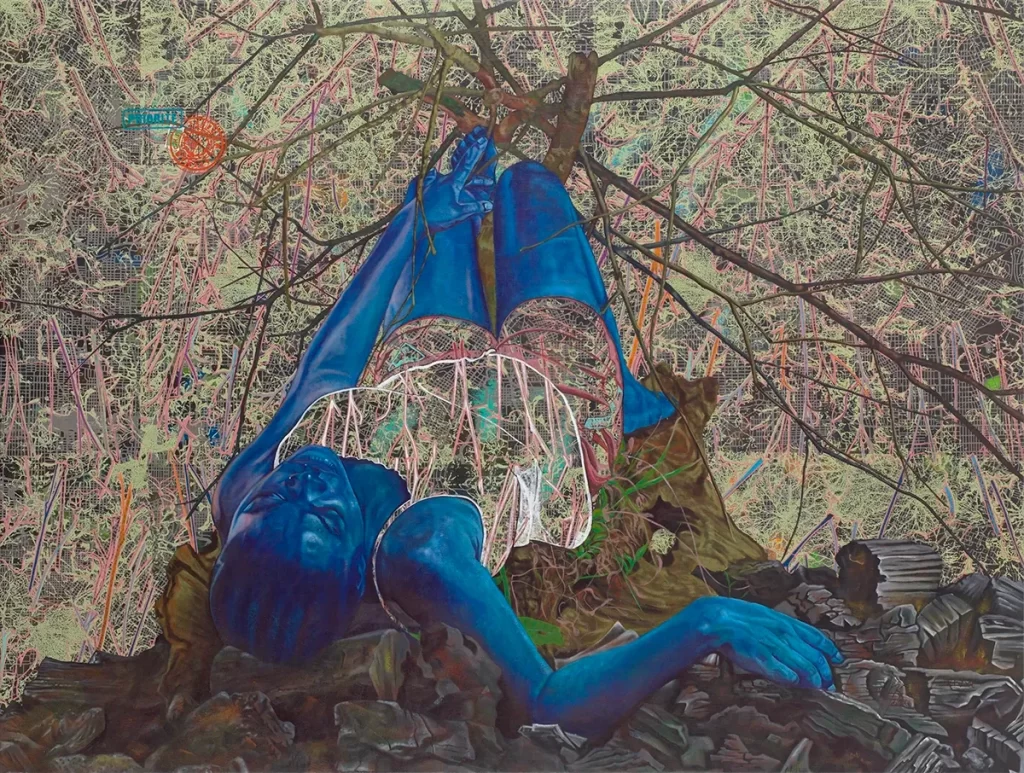
In the paintings, this porosity between body and environment appears in scenes where bluish figures rest on piles of coal and dead wood. Following cotton and cocoa, coal and cobalt extend his exploration of extractive materials. Screen-printed backgrounds, often composed of imagined maps, introduce ideas of territory, appropriation, and the circulation of wealth. Blue, derived from chromatic variations of cobalt, acts as a connecting thread. It condenses multiple meanings: a trace of exploited soils, an index of extractive chains, but also an ambivalent symbol of transformation and transition. In certain traditions, particularly among the Bassa, it refers to widowhood—a liminal time of purification and protection—adding a ritual and symbolic dimension to its material charge. The color thus becomes both scar and threshold.
This dynamic continues in the portrait series created on jute bags, Corps//matière.cm.org. Initiated in 2025 and further developed during a residency in Japan, it marks a shift in the artist’s practice toward modest supports laden with silent histories. By working with materials drawn from cocoa, coffee, or cotton circuits, Nkot does more than inscribe figures onto them: he reactivates their memory. The portrait thus lies at the intersection of material and human experience. It brings individual trajectories into dialogue with the forces of labor, capital, and consumption that traverse and shape the world. Visible seams, tears, and perforations function as bodily marks, evoking scars left by colonial history as well as contemporary working conditions.
In the series Behind a Flag, these same portraits are now deployed on textiles reminiscent of flags. Inspired by strip-weaving traditions from West and Central Africa, these textiles are dyed in colors associated with national flags, without referencing any specific country. The aim is not to represent a flag, but to question what it embodies: a symbol of power, identity, and collective narrative. The screen-printed backgrounds combine archival and contemporary images with fragments of text drawn from the Harkin-Engel Protocol—an agreement by the chocolate industry to comply with the Convention on the Worst Forms of Child Labour (ILO, 1999). Deliberately rendered barely legible, these inscriptions point to the opacity of such international agreements and the persistence of invisible forms of exploitation.
With the ceramic sculptures gathered under the title www//essorage de Gaïa.com, this reflection takes shape through volume and material. Covered in a dense cobalt blue, the figures appear both archaeological and contemporary, as if traversed by an expanded temporality where the memory of the earth overlaps with the history of bodies. The ceramic material, patinated and stratified, evokes both ore and ancient artifact, situating the figures within a geological and historical continuity. Here, cobalt acts as an imprint: it covers, connects, and inscribes. Details of clothing, hairstyles, and jewelry individualize the figures while placing them within a shared regime of display and reconfiguration. The reference to Gaia opens a symbolic reading: that of a nurturing yet strained Earth, placed under pressure by contemporary extractive logics.
By bringing together these three bodies of work—paintings, textile works, and sculptures—the exhibition creates a resonant space in which each medium extends and reconfigures the others. Forms circulate and respond to one another, outlining a conception of matter as a site of memory and tension. Through this “echology” of forms, Jean David Nkot offers an expanded reading of systems of extraction and exploitation, while opening a sensitive space in which human and earthly bodies emerge as sites of passage, tension, and resistance.
Source: AFIKARIS