Juan Carlos Alom
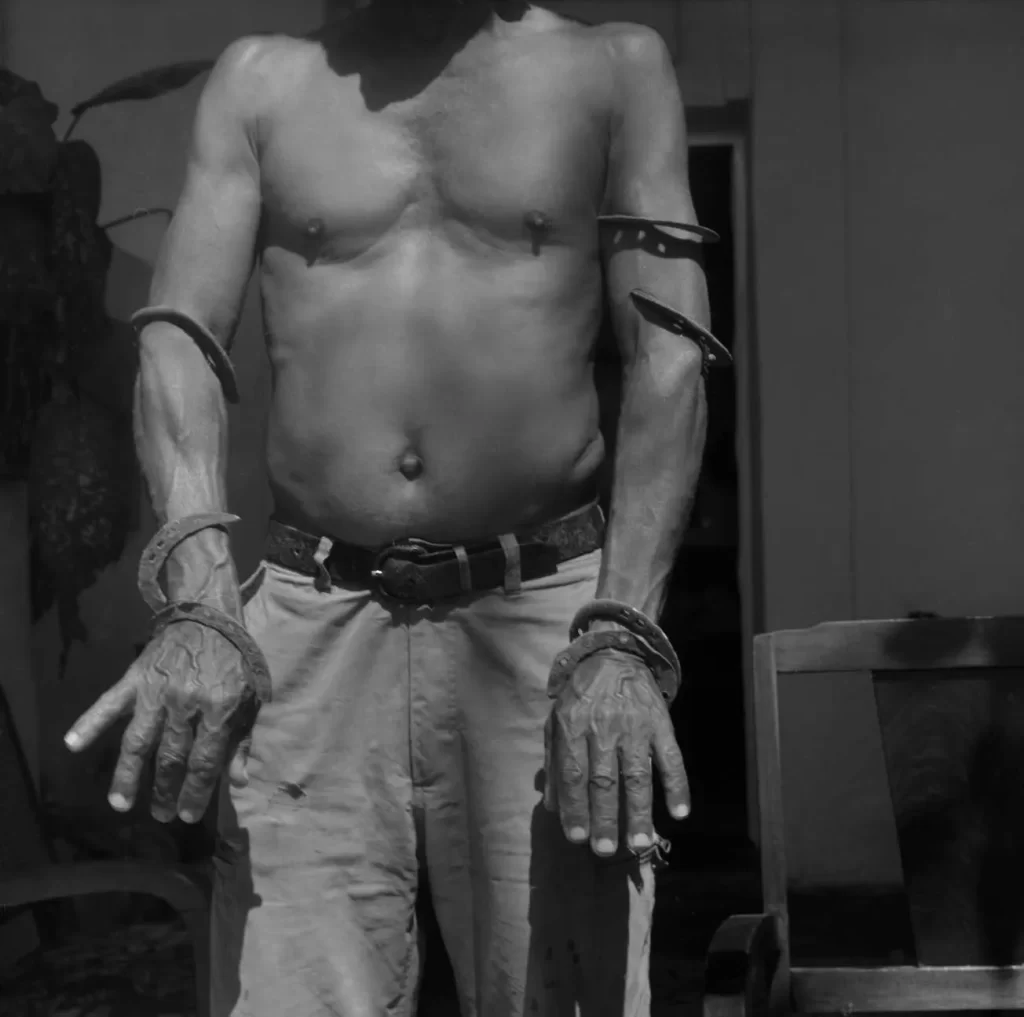
Juan Carlos Alom is one of the most outstanding figures in Cuban photography, documentary cinema, and experimental film. His work, alongside that of other major artists, forms part of the generational drive of the 1990s—a movement determined to reinvigorate the island’s established discourses and aesthetic conventions. Alom’s practice reflects the habits, beliefs, and emotional life of plebeian Cuba. Drawing on the spontaneity and expressive potential of the “domestic” portrait, he develops a spare yet powerful visual language through which he narrates the story of the universal human condition. The sense of precariousness that runs through much of his work, together with his almost exclusive use of black and white, operates not merely as a socioeconomic marker or aesthetic strategy, but as a metaphysical inquiry into Cubans rooted in the posthistorical aftermath of the Revolution.
Eloy Arribas
Regarding his recent work, Eloy Arribas has remarked that his paintings are like songs: spatiotemporal fragments in which heterogeneous elements are brought together to construct a narrative. A narrative without conventional diegesis, built instead through patches, overlaps, and superimpositions. By introducing the operative logic of musical composition into the field of painting, Arribas challenges the medium’s disciplinary framework, dismantling it and opening it up to instability. In this sense, his practice moves away from art history’s central concerns—such as representation (understood as an operation that points beyond the painted surface) or the pursuit of visual effect—and instead operates within a more primary, essential register. For this reason, each of the signs that populate his compositions carries the density and force of reality. The artist refers to these signs as “fossils,” using them to construct a deeply personal, strange, and almost delirious pictorial language—like a lost melody that lingers in the mind of the world.
José Bedia
José Bedia’s work brings together a profound engagement with tribal anthropology and ethnographic research, a sustained commitment to fieldwork, and layered sociological and historiographical inquiry. He is particularly invested in examining the structures and internal logics of iconographic systems across diverse cultural traditions worldwide. As an integral part of his artistic process, Bedia spends extended periods living among Indigenous communities in Africa, Asia, and the Americas. Through these sustained exchanges, he develops relationships that inform his studio practice, deepening his exploration of enduring human archetypes.
Los Bravú
Dea Gómez and Diego Omil have collaborated since 2012 under the name Los Bravú, developing a multidisciplinary practice in which painting remains central. Their distinctive figurative language merges subtle surrealist undertones with neo-Mannerist virtuosity, articulated through a refined logic of collage that brings together references to contemporary design, fanzine culture, and mass media alongside echoes of the Italian Renaissance and early twentieth- century magical realism. Within a single canvas, they combine diverse painterly approaches while preserving the autonomy of each element. Their nuanced and conceptually layered compositions elevate vernacular imagery and mass- cultural icons to monumental scale, offering a critical yet intuitive reflection on identity, representation, and the shifting social realities of contemporary Europe.
Ariel Cabrera
Ariel Cabrera’s project engages in the intervention and dismantling of national historical narratives through the medium of contemporary painting. To this end, he employs strategies of rewriting, erasure, critical re-reading, and fictionalization, focusing particularly on those gray areas that remain undocumented or insufficiently examined. His approach understands national history as a field structured by hegemonic narratives shaped by power—narratives that continue to condition the images and behaviors of contemporary societies. Cabrera freely intervenes in the past, interrogating notions of legitimacy and truth while reconfiguring relationships among historical actors. Drawing from archival and heritage imagery, he ventures into territories rarely explored within Cuban and United States historiography. He establishes dialogues between painting and early photographic practices, incorporating references to the origins of photography and its representational codes. At the same time, he constructs speculative scenarios around military episodes from the wars of Independence, generating parallel events and hypothetical situations that place historiography itself under scrutiny. Sarcasm, erotic-burlesque undertones, and a ludic sensibility permeate his romantic conflicts and intimate scenes—often staged as campaign notes or short narrative fragments—ultimately transforming history into a contested and imaginative terrain.
Ariamna Contino
Ariamna Contino builds her works through the ritualistic and extremely meticulous technique of openwork paper. This labor-intensive process contrasts sharply with the topics she addresses, which are almost always rooted in controversial and highly topical phenomena. Contino has developed a particular interest in historical, environmental, and socio-cultural issues, approaching ongoing conflicts and phenomena that demand continuous reexamination. Using the data gathered throughout her research, she constructs her own visual narratives on subjects such as drug trafficking in Latin America, narco-aesthetics, the underground economy in Cuba, and the trade of classified information. In recent years, her work has shifted toward the interstitial zones between the natural and cultural worlds. From this vantage point, she proposes new approaches to national identity and constructs alternative physiognomies of insularity.
Roberto Diago
Roberto Diago examines the condition of Afro- descendant Cubans within the social landscape of the Revolution. His cultural and sociological perspective allows him to fully grasp the effects of colonial processes on the nations that endured them. These traces are visible not only in forms of marginalization and segregation, but also at epistemic and linguistic levels. In recognition of the depth and relevance of his practice, Diago has been selected as the artist representing the National Pavilion of Cuba at the 61st Venice Biennale, which will take place from May 9 to November 22, 2026, across the Giardini and the Arsenale. This context amplifies his ongoing exploration of identity and resistance, situating his work within one of the most significant platforms for contemporary art. Diago denounces, exposes, and develops exercises in cultural resistance that enable him to speak from a self-aware, maroon subjectivity— one that asserts other religious affiliations, other canons of beauty, and other ways of seeing the white world that dominates the West.
Miren Doiz
Miren Doiz positions her practice at the margins—or, more precisely, within what could be called the “marginal zones” of painting. Her work aligns with a tendency in Spanish contemporary art that seeks to dismantle the aesthetic operations of solemnity in favor of a more immediate and tangible relationship with reality. This is not a nostalgic return to Nouveau Réalisme, but rather the manifestation of a shared generational anxiety: the desire to deactivate the grandiloquence of modernist narratives and their presumed superiority over lived experience. In this recent body of work, the artist approaches painting and sculpture as equally malleable and expandable languages. A subtle Dadaist inflection—tinged with a metaphysical undertone—runs through these baroque, materially dense structures. They form an unmistakably personal bricolage, in the sense articulated by Claude Lévi-Strauss: an intuitive system of construction built from fragments, residues, and displaced meanings.
Diana Fonseca
Diana Fonseca is deeply invested in dismantling—almost obsessively—the apparent simplicity of everyday life. Perhaps for this reason, or due to the lyrical undertone that permeates her practice, she captures fragments of reality and interweaves them into narratives that reflect on disparity and inconsistency, contemporary life and visual saturation, emptiness and banality. Working from a position akin to that of a film editor, Fonseca constructs her pieces as layered collages—palimpsestic mosaics in which fiction and reality unfold simultaneously. Central to her inquiry is the questioning of perceptual mechanisms: why we see what we see, and how discourses of the “real” are constructed—why we say what we say. Guided by these concerns, and without hesitation, she engages minimalist aesthetics, the notion of the unfinished, and modes of visual production that privilege gesture and restraint over the force of totalizing narratives.
Flavio Garciandía
Flavio Garciandía is one of Cuba’s most influential contemporary artists and a seminal figure in the development of conceptual practices in Latin America. He played a central role in the dynamic Cuban art scene of the late 1970s and 1980s and, in 1984, was among the founding members of the Havana Biennial. Garciandía’s painting establishes a profound dialogue with his native Cuba. Through the convergence of diverse postmodern idioms, his work reflects the island’s culture as a site of layered references and hybrid influences. Engaging critically with the history of modern art, his vibrant compositions traverse stylistic territories ranging from Cubism to Conceptualism and Abstract Expressionism. The resulting artistic language—playful yet rigorously self-aware—is one the artist has described, tongue-in-cheek, as “New Tropical Abstraction,” a wry nod to the meteorological term “tropical depression,” evoking both climatic phenomena and the emotional atmospheres of the Caribbean.
Miki Leal
Always working on paper, Miki Leal develops a highly personal and abstract imaginary world with pop and dreamlike overtones. His creative methodology relies on association to discover elements that he later revisits with the energy and versatility that characterize his painting. Among the most recurring themes in his work are his family and domestic environment, his passion for various musical genres, and the presence— serving as a leitmotif—of a symbolic corpus grounded in the geometry of decorative patterns, particularly those inspired by Seville (tiles, mosaics, terrazzo). Regarding his multiple connections to abstraction, he has said: “I have moved through different creative processes, although it has always been the process of an abstract painter, because I always start from white. What matters is to keep painting until something appears—something made of the elements one has in mind at that moment.”
Reynier Leyva Novo
Reynier Leyva Novo’s practice interrogates ideology and the symbols of power, unsettling fixed notions of individual agency and historical authority. Working across disciplines, he mines historical data and official documents, transforming their content into formally austere yet conceptually charged sculptures and multimedia installations. Committed to dismantling myths while foregrounding the fragments of lived experience that sustain them, Novo approaches art as a critical tool of inquiry. This stance has also led him toward civic engagement: he has been actively involved in social movements in Cuba advocating for freedom of expression and political rights, including the artist-activist collective 27N.
Nacho Martín Silva
“Nacho Martín Silva’s painting could be described as an act of retrieval and reconsideration. Retrieval not only because—though the term may sound architectural—the artist reclaims pre-existing images, but because his studio functions as a kind of warehouse, a space where images and artworks—or even failed attempts—accumulate over time. There, works that once seemed untimely or irrelevant are stored away, only to be revisited years later and granted new meaning. The studio becomes something akin to a wine cellar: materials age, and the artist returns to them, decanting and recovering what time has transformed. It is also a kind of cartographic archive. Amid apparent disorder, through a process of searching— or even drifting almost absentmindedly among what has been gathered—the artist encounters fragments, hesitations, or feints that, with the passage of time or in response to the needs of a specific project, reveal themselves as newly pertinent. They operate like flashbacks: returns to the past through remnants that illuminate recently opened solutions and newly trodden paths.”
Eduardo Ponjuán
Eduardo Ponjuán is one of the essential artists in the historiography of Cuban art. His work, which emerged during the eighties, has the ability to go further in the precipice of certain truths, to overcome itself as a discursive generator, to impact, to make us silent, and force us to observe it compulsively. The key point of this, in some way capricious and tremendous, seems to lie in his unlimited talent for invoking that which may be vital to man. From there are born their most fertile and polysemous silences. His work moves in different directions, supported by the alibi of a conceptualism that has reinvented itself again and again. Sometimes he speaks with a slight monosyllabic accent, sometimes he becomes scathing and shouts without any inhibition. There isn’t a precise and fair way of cataloging him, because in his case any taxonomy becomes reductionist. Ponjuán is a painter, an installationist, a draftsman, a conceptual artist, and an inexhaustible thinker. The whole art is a starting point for him, the trough where he takes what he needs to interrogate the world.
Lázaro Saavedra
Lázaro Saavedra develops his practice from a rigorously conceptual perspective, permeated by irony, parody, and sharp humor. His work incisively examines the political, social, and cultural tensions embedded in Cuban reality, addressing issues such as censorship, structures of power, ideology, and the role of art within society. Working across installation, drawing, video, and object-based practice, Saavedra formulates critical strategies that prompt reflection—often through provocation or the subtle deployment of double meanings. In recent years, his research has increasingly focused on processes of communication, the circulation of information, and the interplay between the virtual and the physical. From this vantage point, he continues to interrogate the boundaries between art and ethics, as well as the social responsibility of the artist.
Source: EL APARTAMENTO